📑 Table of Contents
- What Is BMI and How Is It Calculated?
- Standard BMI Ranges According to WHO and CDC
- Real Examples: BMI for Common Heights and Weights
- Does BMI Work the Same for Everyone? Ethnic and Population Differences
- When BMI Is Not Enough: Athletes, Bodybuilders, and Muscle Mass
- Very Low BMI: What the Numbers Mean Clinically
- How to Lower Your BMI: What Actually Works
- How to Use the BMI Calculator on This Page
The CDC says 73.6% of American adults are overweight or obese but most people don’t really have a clean reference point for where their own weight sits on that whole spectrum. Body mass index, BMI, kind of gives you that reference in seconds. You drop your height and weight into the free BMI calculator, and you get a number that maps to a clinically established weight category. It is not the full picture health assessment though, it’s more like the first rung, that most healthcare providers lean on, and honestly knowing what it means is more useful than just ignoring it.
This article goes into how BMI is calculated, what each number range means, where the standard formula shows real limits for athletes, for folks of Asian descent, for Black women, and what practical steps actually shift the number if you want it to change.
What Is BMI and How Is It Calculated?
Body mass index is kind of like a ratio between how much you weigh and your height, sort of. You calculate it by taking your weight in kilograms and dividing by your height in meters squared, not the other way around. In US units, the equation relies on pounds and inches, and there is a correction factor of 703, because you know… units. Still, neither version really accounts for age, sex, ethnicity, or how much muscle mass you actually carry and that’s exactly where BMI has limits, and why getting those limits right matters just as much as knowing the single number.
BMI was devised by the Belgian mathematician Adolphe Quetelet sometime in the 1830s, and it was not actually made as a clinical health tool, it was meant more like a statistical measure, for looking at groups of people. Later on, it really caught on in medicine after the 1970s because it’s kind of simple, inexpensive to compute, and it tracks body fat fairly well across big populations.
The BMI Formula — and What the Number Means
In metric style, BMI is basically weight in kg, divided by height in meters squared. Like, if someone is 1.65 m tall and weighs 75 kg, then BMI = 75 ÷ (1.65 × 1.65), and it ends up around 27.5.
In the US measurement setup, things sort of look different: BMI = 703 × weight (lbs) ÷ height (inches)². Say, for a woman who’s 5'4", so 64 inches, and she weighs 165 lbs, you’d compute BMI = 703 × 165 ÷ 4096 = 28.3. That number basically sits in the “overweight” category.
The calculator takes care of both metric and imperial inputs, you don’t have to convert units or mess with the formula by hand. Just type your height and weight in whatever system you’re using and the result shows up right away.
Standard BMI Ranges According to WHO and CDC
The World Health Organization along with the US Centers for Disease Control, use the same adult BMI thresholds. It’s for adults aged 20 and older, no matter the sex. For children and teenagers, BMI is calculated the same way but interpreted using age- and sex-specific growth chart percentiles — a child's BMI result should always be evaluated by a pediatrician, not compared directly to adult ranges.
| BMI Range | Category | Health Risk |
|---|---|---|
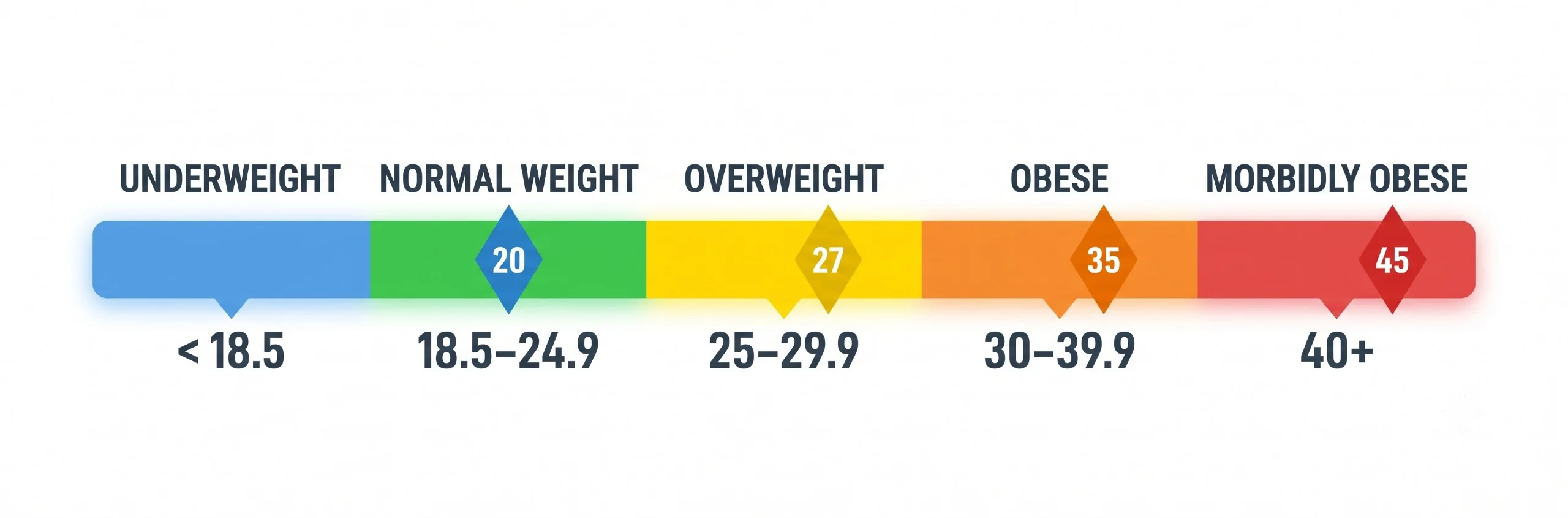
| Below 18.5 | Underweight | Nutritional deficiency risk, immune function concerns |
| 18.5 – 24.9 | Normal weight | Lowest risk for weight-related conditions |
| 25.0 – 29.9 | Overweight | Elevated risk for type 2 diabetes, hypertension |
| 30.0 – 34.9 | Obese (Class I) | Significantly increased cardiovascular risk |
| 35.0 – 39.9 | Obese (Class II) | High risk; often qualifies for medical intervention |
| 40.0 and above | Obese (Class III) / Morbidly Obese | Severe risk; surgical options may be discussed |
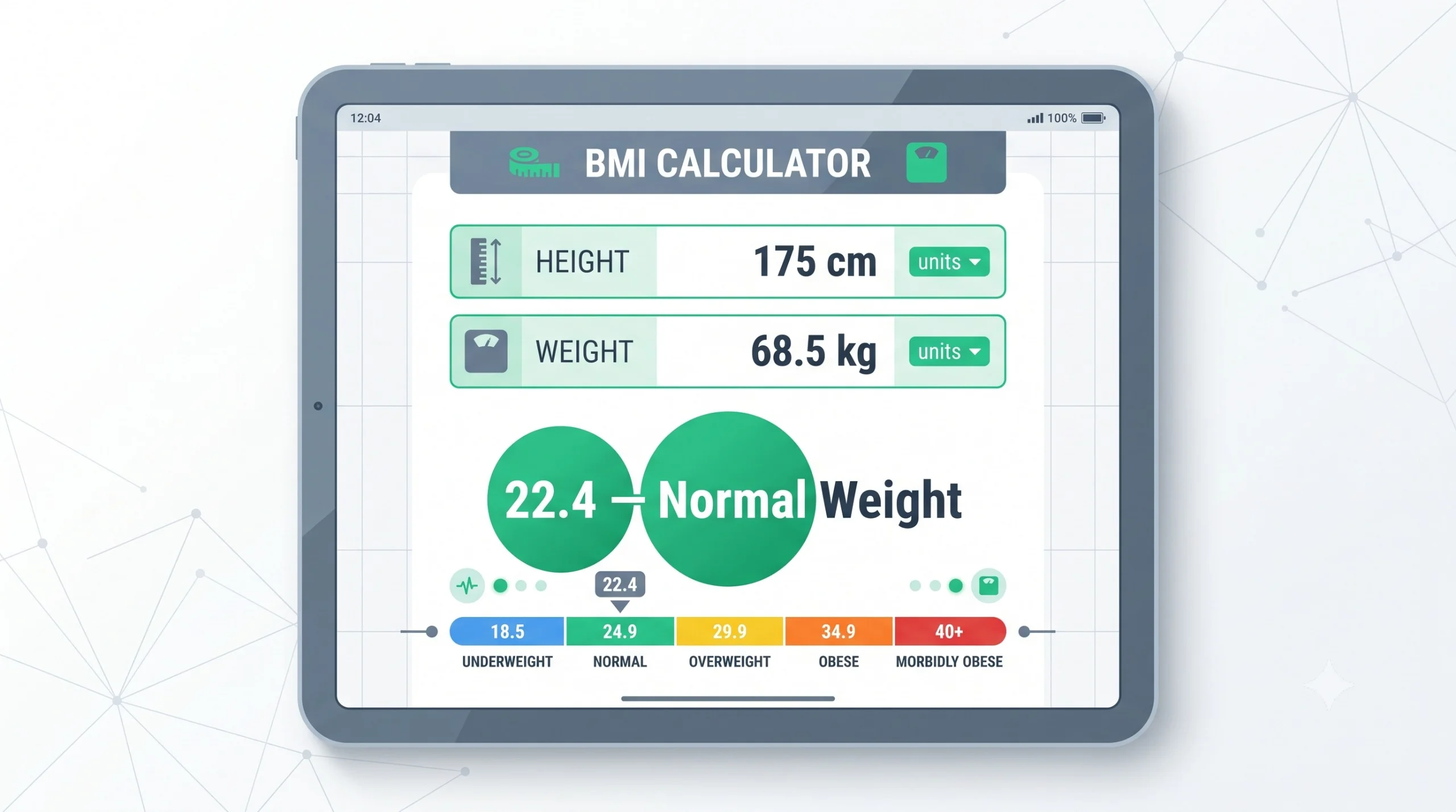
A BMI of 20 sits pretty solidly in the normal bracket. People who search “what does a BMI of 20 look like” are often trying to picture what their body would look like, at that exact number. The NHS calls this band “healthy weight”, and statistically it lines up with the lowest chance of cardiovascular disease, type 2 diabetes, and joint issues compared with other BMI categories.
Real Examples: BMI for Common Heights and Weights
Since BMI depends on both height, and weight really, sort of in tandem, it’s possible for two people who look very different to land on the same number. For example, a woman at 5'4" and 165 lbs (BMI 28.3) and a man at 5'10" and 205 lbs (BMI 29.4) can both fall into the overweight range but their body composition, health risks, and what the right kind of next steps looks like are probably pretty different.
A BMI of 39.0 puts someone in Class II obesity, which is above the point where most clinical weight management programs start to take action, but it’s still under the Class III cut off at 40. A BMI of 45 is Class III obesity, and it’s sometimes described as morbid obesity. At this stage, regular lifestyle changes tend to work less often, so bariatric surgery can become a medically backed option for a lot of patients. These labels are clinical instruments used by doctors, insurers, and surgical teams, not moral judgements.
Does BMI Work the Same for Everyone? Ethnic and Population Differences
The short answer is no. BMI thresholds were developed primarily from data on European populations. Decades of research since then have shown that the relationship between BMI and metabolic health risk differs meaningfully by ethnicity. A body type calculator can supplement BMI with body shape and proportion data for a more complete picture.
BMI for Asians and Asian-Americans
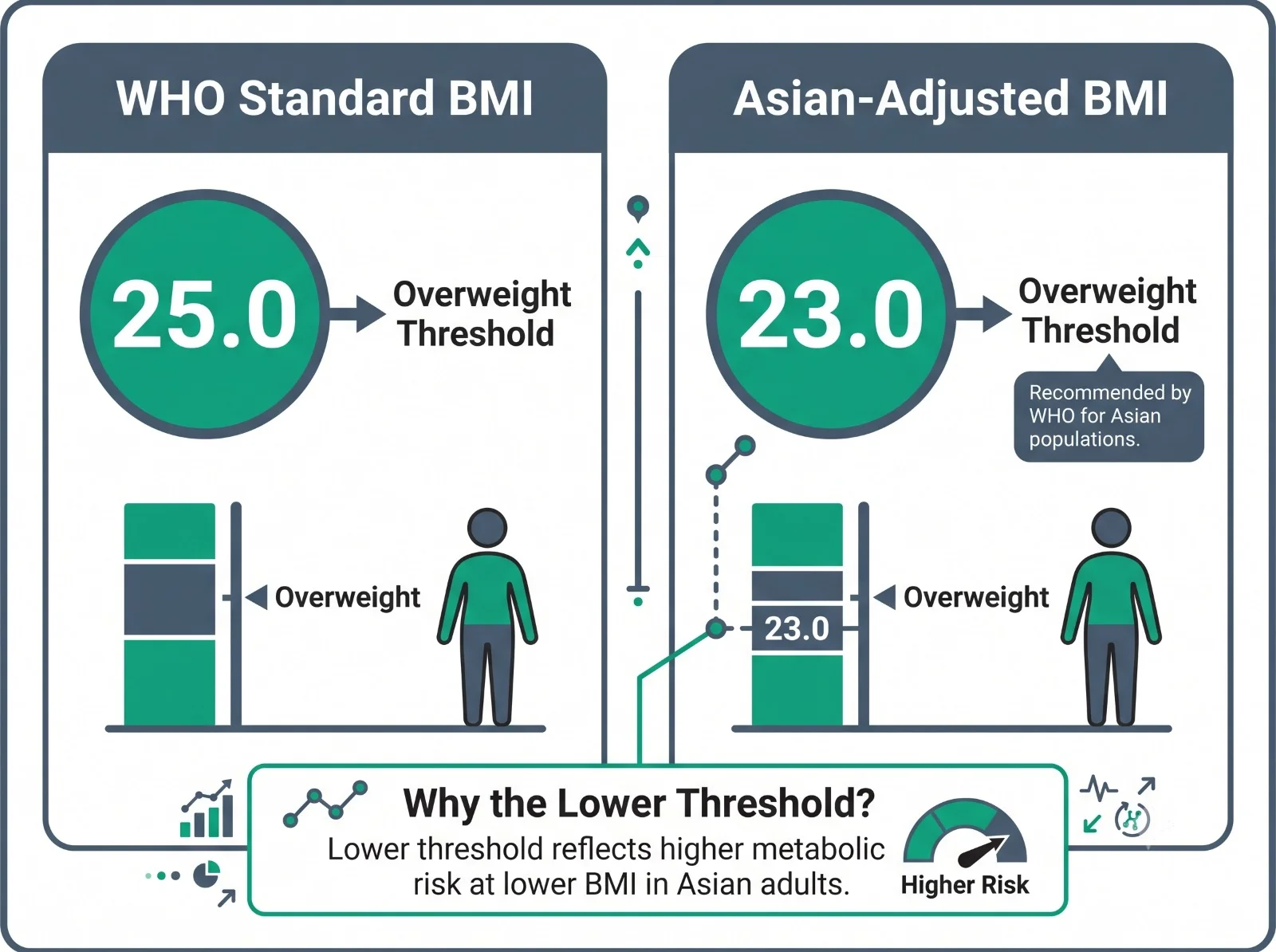
The metabolic risk levels for adults belonging to Asian ethnicities including Korean, Chinese, Japanese, South Asians, and South-East Asians are higher even at low BMI levels than the current benchmarks indicate. This fact was recognized by the World Health Organization, and the WHO released an official technical report recommending the use of reduced benchmarks for determining the risk level in Asia, wherein overweight individuals will have BMI between 23.0 to 25.0 and obese will be those with BMI between 27.5 to 30.0.
This implies that when the BMI of a Korean adult comes out to be 24, then it means that he or she is having elevated risks of developing type 2 diabetes and cardiovascular diseases, as compared to an adult belonging to Europe. The standard calculator gives you the number; knowing that the risk thresholds are lower for Asian populations gives that number proper context.
BMI for Black Women and Black Adults
According to research carried out in journals such as JAMA Internal Medicine, the established BMI criteria can overestimate the risk of metabolic complications among Black adults – especially Black females – as much as those of white adults for the same BMI value. Research shows that at a BMI level of 27-30, the cardiovascular risk profile of Black females is comparable or even lower than white females. This does not mean BMI is irrelevant for Black adults. It means the standard thresholds designed from predominantly white population data are an imperfect fit, and results in this range warrant clinical interpretation rather than alarm. Also, looking at waist circumference and visceral fat, kind of adds more context since BMI by itself just doesn’t really capture that whole picture.
When BMI Is Not Enough: Athletes, Bodybuilders, and Muscle Mass
BMI is basically a weight-to-height ratio. But it can’t separate, like, a kilogram of fat from a kilogram of muscle, so the interpretation gets a bit messy. For athletes and bodybuilders, this creates a systematic problem: high muscle mass produces a high BMI even when body fat percentage is low. An elite rugby player at 6'1" and 230 lbs has a BMI of 30.4 technically obese by the standard definition. Their body fat percentage may be 12%.
Athletic BMI is not a different formula it is an acknowledgement that the result needs to be interpreted alongside body composition data. The body fat calculator uses waist, neck, and hip measurements to estimate fat percentage using the US Navy method. For anybody who exercises regularly, lifts weights, or participates in sport, trying the BMI and body fat calculators in tandem, gives a way more accurate view of overall health than using BMI alone.
Like, consider a bodybuilder with a BMI of 33 and 8% body fat. That person really isn’t in the same health bracket as a sedentary individual with a BMI of 33 and 32% body fat. BMI does not make that distinction. Body fat percentage does.
Very Low BMI: What the Numbers Mean Clinically
And a BMI under 18.5 counts as underweight. Under 17.5, clinical guidance including the ones used by the NHS flags that cut-off as a potential sign of serious nutritional deficiency. At these levels, the body begins drawing on muscle and organ tissue for energy, immune function deteriorates, and bone density declines.
People who are searching for “anorexic BMI calculator” usually end up wanting to know what the clinical markers look like when someone has a low body mass index, meaning, around what BMIs people are considered to be moving through different stages of underweight based on the clinical literature. A BMI below 15, for example, is typically taken as a very serious situation of malnutrition and in medical practice it’s regarded as an emergency. It’s not something to aim for, more like a threshold marker that clinicians use. Similarly, 'BMI to be a model' is a search that reflects real industry pressures. Fashion industry BMI requirements vary by agency and country. The French government passed legislation in 2017 requiring models to present a doctor's health certificate and banning agencies from hiring models below a BMI of 18. Many other countries have adopted similar voluntary codes. A BMI below 18.5 is, by every major health authority's classification, underweight.
How to Lower Your BMI: What Actually Works
BMI decreases when weight decreases specifically when fat mass decreases. To lose weight sustainably you usually need to keep a calorie deficit going over time, like eating a little less than what your body spends, steadily, not going so extreme that you end up getting hit by compensatory overeating or some kind of metabolic pushback.
That’s where a calorie calculator helps: it estimates your total daily energy expenditure TDEE, basically the calories your body needs for your current weight plus your activity level. If you create a deficit of about 500 calories each day you’ll average around one pound of fat loss per week, which is near the upper side of what most sports medicine frameworks call “doable” for long term progress. Then a protein intake calculator, makes sure you’re taking in enough protein to protect muscle while you’re trimming fat, because when muscle mass drops your metabolic rate can follow, and future weight management becomes way more stubborn.
Also hydration is not just about feeling ok, it can influence appetite as well as metabolism. The water intake calculator gives a personalized daily fluid target based on your weight and activity level. These three tools — calorie target, protein target, and hydration target — address the three most evidence-based dietary levers available for BMI reduction.
How to Use the BMI Calculator on This Page
Using the BMI calculator takes under 30 seconds. Select imperial or metric. Enter your height in feet and inches, or in centimeters. Enter your current weight. The calculator will tell you your BMI, the group where it lands, and the “healthy” weight zone that matches your height.
The healthy weight range is useful context that a single BMI number does not always make clear. So if someone is 5'6" (168 cm) tall, then their healthy weight should hover around 115 to 155 lbs (52–70 kg) since their BMI, stays in the 18.5 to 24.9 bracket.
For a more complete health picture, follow up with the body fat calculator and the calorie calculator. BMI tells you where you are relative to population averages. Body fat percentage tells you what your weight is made of. Calorie output tells you what adjustment is needed to change it. Used together, these three tools on EasyFreeCalculator give you a data-informed starting point for any health or weight management goal.