📑 Table of Contents
- What a Percentage Calculator Does — and Why You Need One
- The Percentage Formula: How to Calculate a Percentage on Any Calculator
- Formula 1: What Is X% of a Number?
- Formula 2: What Percentage Is X of Y?
- Formula 3: X Is What Percent of What Number? (Reverse Percentage)
- How to Convert Marks to Percentage
- Step-by-Step: Marks Percentage Calculator
- How to Calculate the Percentage of a Mark in Practice
- Percentage Calculator from Two Numbers: Finding X as a Percentage of Y
- Worked Examples: What Percentage Is 1 in 3? What Is 3/2 as a Percentage?
- How to Calculate a Percentage Increase or Decrease
- How to Calculate an Average Percentage
- Common Percentage Mistakes — and How a Calculator Prevents Them
A 2022 survey by the National Assessment of Educational Progress found that only 26% of U.S. eighth-graders scored at or above the proficiency level in mathematics, and those percentage calculations have been pretty consistently counted among the most commonly missed question types, like all the time though. The issue is not intelligence it is just that percentages show up in a bunch of different guises and many people learned one single formula not all of them.
The free percentage calculator on this page handles all of it, including finding a percentage of a number, figuring out what percent one number is of another, reversing a percentage, percentage change, and a bit more.
What a Percentage Calculator Does — and Why You Need One
A percentage calculator takes two or three inputs, then it uses the proper math relationship between them and gives back the outcome. The reason people grab a calculator instead of doing it by hand is not really that the math is difficult it’s more that the individual steps are simple. The catch is that the three main kinds of percentage questions need different formulas, and if you mix them up, you end up with wrong answers, even if each step seems reasonable.
Research from the University of Chicago Booth School of Business found that even financially literate adults make systematic percentage errors when working mentally particularly with percentage increases applied in sequence (like two successive discounts). A calculator eliminates that error category entirely. According to a 2021 report by the American Institute of CPAs, spreadsheet and calculation errors cost US businesses an estimated $2.8 billion annually, with percentage miscalculations cited as a primary contributor in financial modeling.
The three core calculation types are: finding what X% of a number is, finding what percentage X is of Y, and finding the original number when you know a percentage of it. Each one is a different algebraic manipulation of the same relationship. The calculator handles all three you do not need to identify which formula applies before you start.
The Percentage Formula: How to Calculate a Percentage on Any Calculator
That underlying percent bond is basically always this: Percent = (Part ÷ Whole) × 100. Everything else is kind of just a rearrangement of that same relationship, so you can swap the pieces around a bit and it still holds, mostly. Understanding the three rearrangements means you can solve any percentage problem with the same formula, regardless of which value is missing.
Formula 1: What Is X% of a Number?
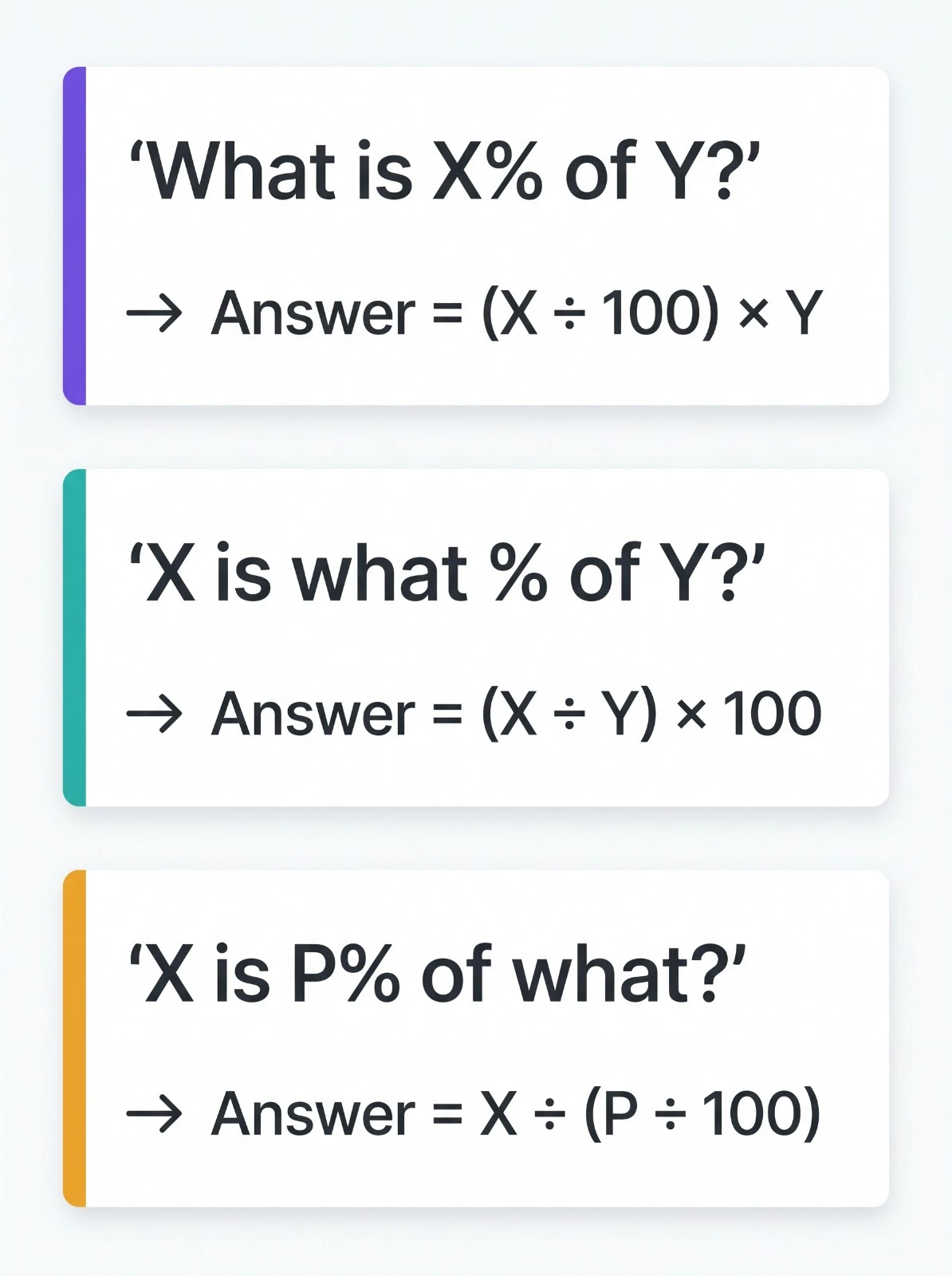
This is the most common percentage calculation. Now the other formula, the one for “what part is X percent of Y,” goes like this:
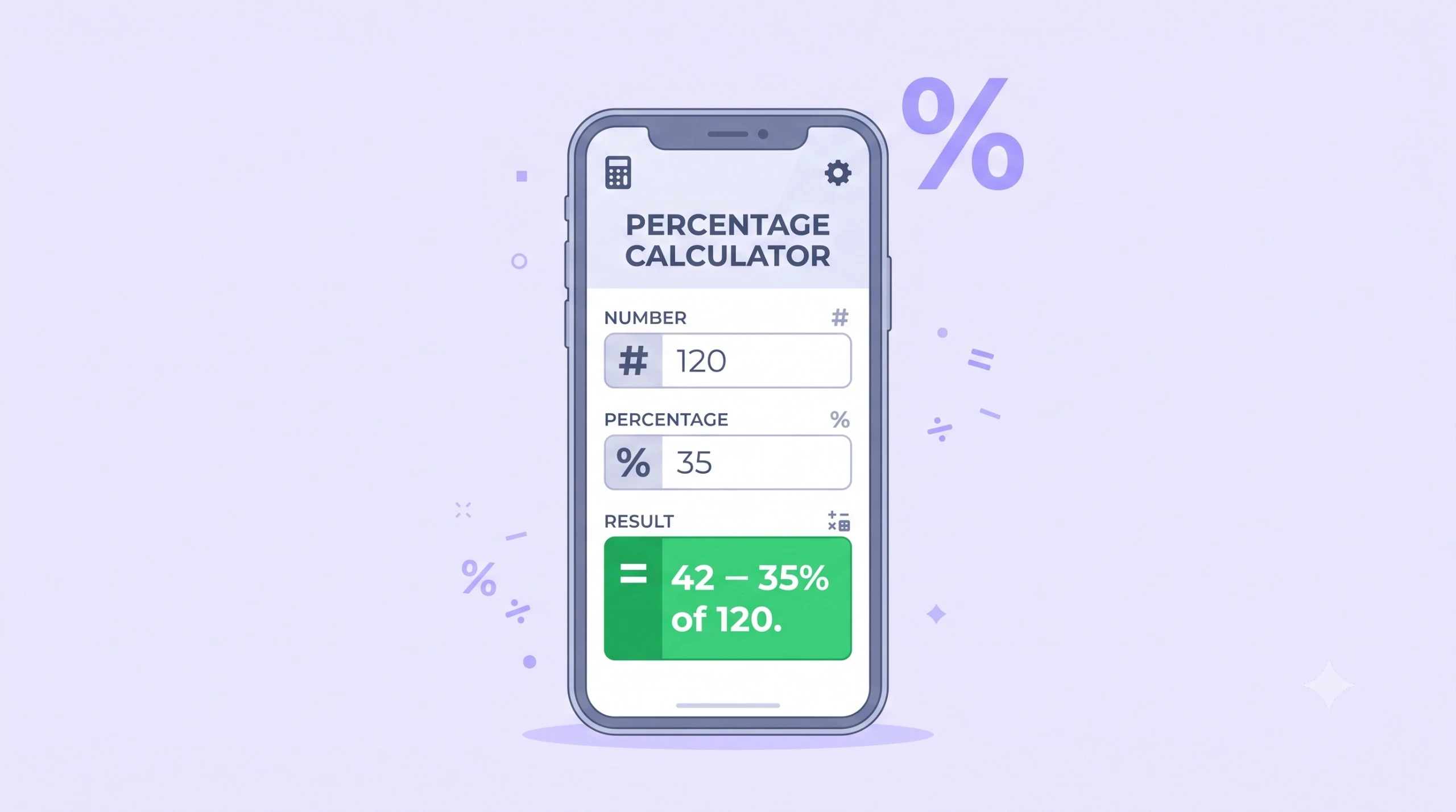
For example, what is 35% of 120? Answer = (35 ÷ 100) × 120 = 0.35 × 120 = 42. On a physical calculator, you would enter 120 hit ×, then type 35 press %, then press =. On most phone calculators, the % key turns the preceding number into a decimal automatically, a bit like it “knows” what you mean. Here on this site’s online percentage calculator, you can just plug in both values and pick the calculation type.
Formula 2: What Percentage Is X of Y?
This rearrangement kind of figures out what percentage one number is of another, sort of like when you want to see how much of it is really there. You can think of it as a quick check, the formula is:
So then if you ask what percentage is 18 of 72, you do Answer = (18 ÷ 72) × 100 = 25%. It’s basically the same kind of step a teacher does when they switch a raw score into a percentage grade, you know that standard conversion, like a routine thing. What is x as a percentage of y follows that same setup, meaning you take x over y then you multiply by 100. A ratio calculator also talks about a closely related scenario where you must show the relationship as a simplified ratio, not really as a percentage.
Formula 3: X Is What Percent of What Number? (Reverse Percentage)
Reverse percentage is basically the way you “go back” to the original number, once you already have the part and the percent. You can use this setup:
So if a discounted price of $68 turns out to be 85% of the first thing, then the starting value was $68 ÷ 0.85 = $80. Shops and stores use this all the time, it is the method for working backwards from a sale amount to the pre-discount amount, like it is just silently every day.
How to Convert Marks to Percentage
The marks-to-percentage conversion is one of the most searched percentage calculations, pretty much worldwide, and it gets pushed especially by students in India, the UK, Pakistan, and Australia. That’s because results are often published as raw marks over a total. The formula is same as mentioned above that is (marks obtained / total marks) × 100. There is no other twist in this calculation.
Step-by-Step: Marks Percentage Calculator
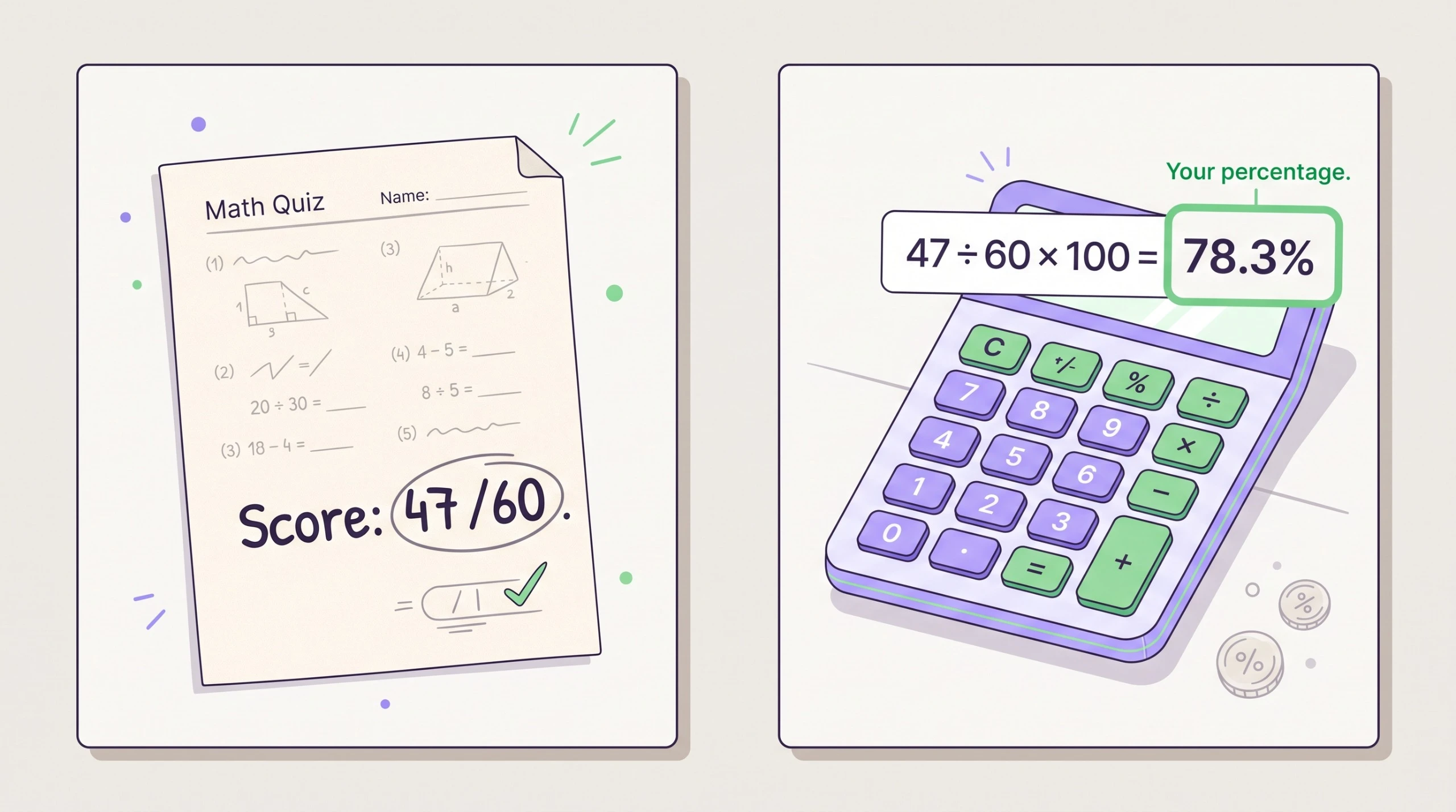
When a pupil receives 47 marks from 60 then he can simply calculate the percentage by using the formula as (47/60)* 100=78.33 (you know simple mathematics). If one other student receives 315 marks from 400 in five papers then again we can use the same formula (315/400)*100=78.75. This means that despite the number of marks that the students got and also the fact that different exams can have different system working with the number of marks assigned, the formula remains unchanged.
Aggregate percentages of subjects with different total marks, let's say, of five papers that carry 100 marks each is simply adding their total score (for example 72 + 68 + 81 + 75 + 69 = 365) divided by the sum total (500), and multiplying by 100: 365 ÷ 500 × 100 = 73%. After this stage, the grade curve calculator works on the further step where it curves the results where the examiner applies curve.
How to Calculate the Percentage of a Mark in Practice
This same idea kind of shows up when the mark is written as a fraction, not just a plain score. Like, what percentage is 3/2? You first turn it into division: 3 ÷ 2 = 1.5, then you do 1.5 × 100 = 150%. So any fraction larger than 1 ends up giving you a percentage above 100% and honestly that’s fine, it even pops up in percentage increase moments too. Now if you ask for the percentage of 1/3, you calculate 1 ÷ 3 × 100 = 33.33%. A fraction calculator will usually simplify the fraction first, and that tiny step helps, especially when you’re stuck with awkward exam-style mark fractions, or when you just want to juggle fewer numbers.
Percentage Calculator from Two Numbers: Finding X as a Percentage of Y
The percentage calculator from two numbers kind of gets the idea across, like, if you feed it any two values, it tells you the percentage kind of relationship between them, or at least that’s what it’s doing. Basically you punch in both numbers and it gives back the percentage that the first one stands for, of the second one. It shows up in salary comparisons (your raise as a percentage of your prior salary), budget tracking (expenses as a percentage of income), and also in test scoring.
Worked Examples: What Percentage Is 1 in 3? What Is 3/2 as a Percentage?
So what percentage of 3 is 1? It’s basically the setup, 1 ÷ 3 = 0.333..., then you multiply by 100 so you get 33.33%. And like, if you want to think probability-wise, “1 out of 3 chances” is pretty much 33.33% of the time. So imagine there are 30 students in the class, and 10 of them passed, then “10 as a portion of 30” sounds like (10 ÷ 30) × 100 = 33.33%. Fine.
Now what about the percentage of 3/2? You can kind of treat 3/2 as 1.5 in decimal, then 1.5 × 100 = 150%. This sort of result shows up when you’re doing “percentage of” in a ratio way, meaning you’re basically turning 3/2 into the comparison term. Like, if something goes from 2 to 3, the new-to-old relationship is 3/2 and that corresponds to 150% of the earlier number. But yeah, what you actually notice as a change is only an increase of 50%, not some crazy 150% increase.
How to Calculate a Percentage Increase or Decrease
A percentage increase usually looks like: ((New Value − Old Value) ÷ Old Value) × 100. So, for example, if something goes from $40 to $52, it seems straightforward, and you do (($52 − $40) ÷ $40) × 100 which comes out to 30%. Percentage decrease uses the exact same pattern, and if the final result comes out negative, that means it’s a drop. Example, a salary cut from $65,000 to $58,500 gives (($58,500 − $65,000) ÷ $65,000) × 100 = −10%. So that’s really a 10% decrease.
In practice, a percentage decrease calculator just takes care of the decrease specific computation, without fuss. It’s where it really counts in retail: a product marked down from $89.99 to $67.49 comes out to be reduced by exactly 25%. The “from two numbers” percentage trick lands you there, (89.99 − 67.49) ÷ 89.99 × 100 = 25%.
How to Calculate an Average Percentage
This is where most people get their first percentage error, like they sort of rush it. For instance if a learner gets 70% on one exam and 80% on the other, the mean percentage doesn’t just magically become 75%. It only feels that way when both exams have the same weight, like the same total marks overall, right. But if the first exam was out of 50 and the second out of 100, then you cannot simply mix those two percentages. You really have to do the math on the real scores: 70% of 50 = 35 marks, and 80% of 100 = 80 marks. Total marks earned: 115. Total marks possible: 150. Then the overall percentage is (115 ÷ 150) × 100 = 76.67%, and not 75%.
The main idea (kinda) is this: if your sample sizes differ, you should go back to the raw scores, not the percentages. You add up the marks, divide by the full possible total, and then multiply by 100. The average calculator handles the mean calculation when you have equal-weight percentages and just need the arithmetic done quickly.
Common Percentage Mistakes — and How a Calculator Prevents Them
The most frequent slip is when people apply a percentage increase, then a percentage decrease, and sort of assume it will bounce back to the original. But it really does not cancel out, like not in any straightforward way. A 20% increase followed by a 20% decrease is not a net zero. Also if you begin at 100, and you apply a +20% change you end up at 120, that is basically the key picture. Then after −20% on 120, you land on 96, not 100. The two percentages operate on different base values.
The second common mistake is confusing percentage points with percentages. If an interest rate goes from 3% up to 4%, then it moved by 1 percentage point but it rose by 33.33% in relative terms, since it’s 1 ÷ 3 × 100. These are different things, and mixing them up produces materially wrong statements about financial data.
A percentage calculator on a page like this one prevents both errors because it always applies the formula to the value you enter not to a value you assumed. Enter the numbers, read the result, and the arithmetic is reliable. Use EasyFreeCalculator for any percentage problem where an error would cost you money, marks, or time.