📑 Table of Contents
A 2022 OECD report said almost half of adults in developed countries have trouble finishing math tasks that go past basic arithmetic. That gap messes with real day to day stuff—figuring a sale price, splitting a bill, making sense of a test score, or checking a dosage. A solid online math calculator basically takes away the friction. It delivers the right number quickly, no lecture , no textbook.
This page gathers 14 free math calculators that cover a bit of everything: everyday percentages , geometry, statistics, and scientific unit conversions. Each tool on EasyFreeCalculator is free, works instantly on any device, and doesn’t ask for sign up.
Who Actually Uses Online Math Calculators?
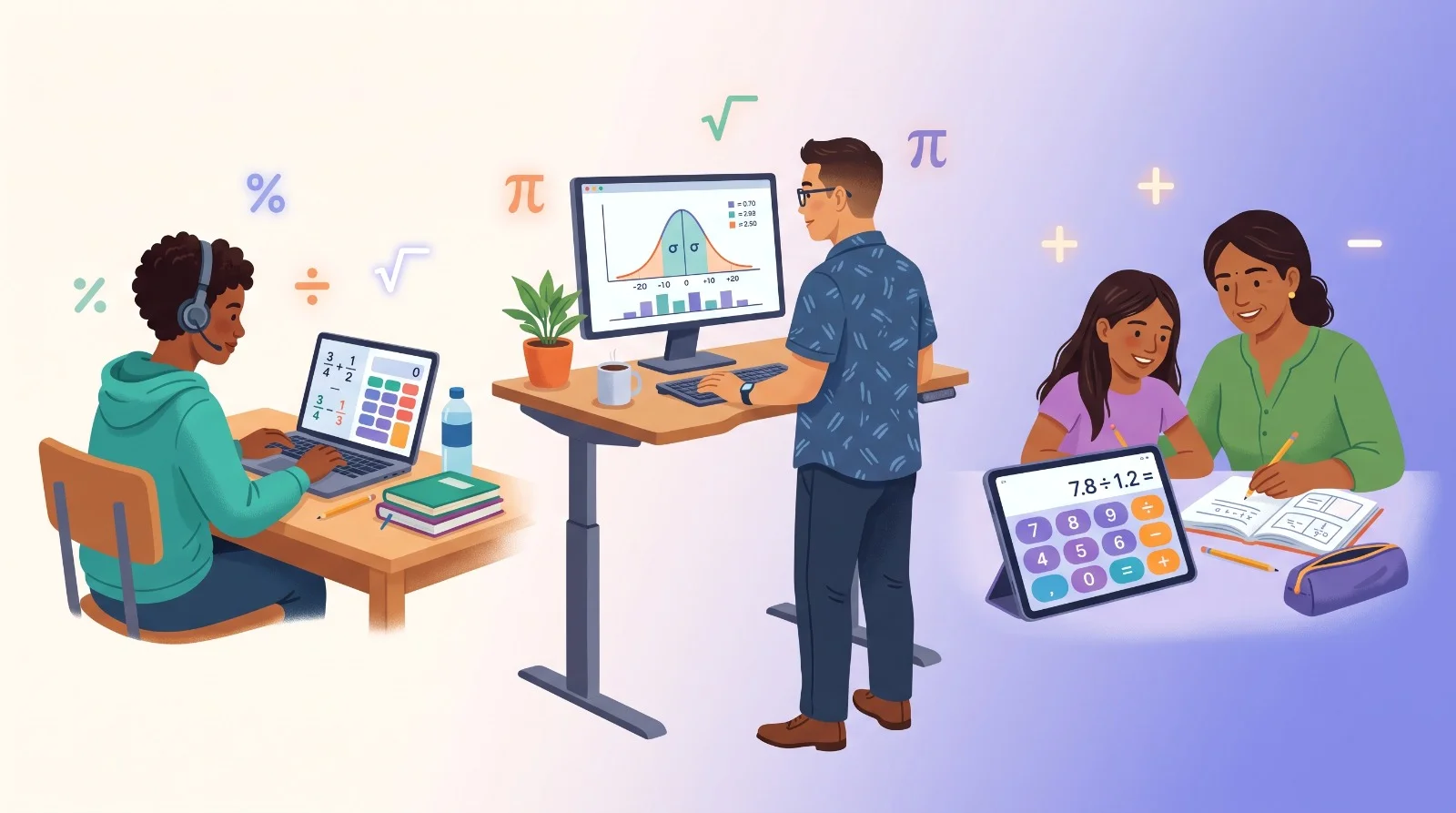
The short answer is… almost everyone, at some point. But the more useful view is by situation. Students use them to double-check homework, confirm their steps, and spot where things went off. According to the National Council of Teachers of Mathematics, calculator use in classrooms when it’s paired with conceptual teaching can boost problem solving performance. The aim is really to understand the answer, not simply to collect it or “get it” and move on.
Teachers and tutors also rely on them for quick examples, to check computations before a lesson, and to demonstrate students more than one path through the same puzzle or question. People in practical careers like engineering, nursing, construction, and finance depend on these tools for specialized work standard deviation for data analysis, area for spatial planning, unit conversion for technical specifications so they don’t have to pivot to heavier, bigger software just to do the math.
Parents use them at homework time. Hobbyists use them for genealogy (Punnett squares), game design (exponents), and cooking (ratio scaling). Math calculators are not just for school — they sit at the intersection of everyday life and precise arithmetic.
The Math Tools People Use Most
Here’s sort of what each calculator does, and who most often grabs for it, when things get a little messy.
Percentage Calculator
The Percentage Calculator handles three main percentage things: figuring out what percent one number is compared to another, computing a percent of a given number, and then working backwards from a percentage to get the original value. Honestly it’s one of the most searched math calculator types online, and people use it everywhere, from quick tip math to interpreting test scores, to retail markdowns and those discount tags.
Fraction Calculator
The Fraction Calculator helps you add, subtract, multiply, and divide fractions including mixed numbers too and it shows the outcome in a simplified, cleaner form. It tends to be especially handy for students who are learning fraction operations, but it also shows up for everyday work like recipes, measurements, or construction dimensions, where fractional pieces are pretty common.
Ratio Calculator
The Ratio Calculator is for simplifying ratios and also finding the missing number when you’re working with proportions. It shows up a lot in cooking, like scaling a recipe, and in map reading, for distance to real world conversions. Also it’s used in any situation where two amounts need to stay in balance, in proportion, and people don’t want to do the reasoning by hand and hope it’s right.
Standard Deviation Calculator
The Standard Deviation Calculator measures how scattered a set of numbers is around the average. It’s a key statistics tool, used in research, data analysis, and quality control. Students in AP Statistics, psychology, and biology will use it a bunch. Meanwhile professionals in finance, manufacturing, and healthcare rely on it to judge variability in their data sets, you know, the spread that’s not always obvious at first.
Area and Triangle Calculators
The Area Calculator figures out the area of everyday forms squares, rectangles, circles, triangles, trapezoids, and more using the measurements you type in. The Triangle Calculator works out the missing sides and angles, kind of like, with the law of sines and cosines. They’re both used in construction, architecture, landscaping, and also in geometry homework, course work.
Long Division Calculator
This Long Division Calculator does the division one step at a time, and it displays the complete work , the quotient , the remainder, and each middle step. So it’s handy not only for reaching the final answer, but for seeing how the process actually plays out. It’s one of the rare math tools that teaches while it calculates.
Average Calculator
The Average Calculator gets the mean of any group of numbers. Just enter your values and it manages the adding and the dividing by itself. You’ll see it used everywhere from grading, where test scores get averaged, to fitness tracking like average pace or weight, to summarizing data in reports, basically.
Exponent Calculator
The Exponent Calculator raises any base number to any power, including fractions and negatives. It handles calculations that a basic calculator cannot large scientific notation values, fractional exponents (which are equivalent to roots), and negative exponents (which represent reciprocals). Frequently used in physics, chemistry, and compound growth calculations.
Roman Numeral Converter
The Roman Numeral Converter translates between standard numbers and Roman numerals in both directions. Useful for history students, those reading clocks, legal documents, or film credits, and anyone who encounters Roman numerals in contexts where the meaning is not immediately obvious.
Punnett Square Calculator
The Punnett Square Calculator predicts the probability of genetic trait combinations across parent genotypes. Biology students use it for genetics assignments. It automates a grid-based calculation that is easy to set up wrong manually, especially for dihybrid (two-trait) crosses.
Percentage Decrease Calculator
The Percentage Decrease Calculator calculates how much a value has dropped as a percentage. Useful for comparing prices before and after a discount, tracking weight loss, analyzing sales declines, or evaluating any drop between two figures. It is the specific counterpart to a general percentage calculator when the direction of change matters.
Grade Curve Calculator and Chemistry AP Score Calculator
The Grade Curve Calculator adjusts raw test scores based on a curve — useful for teachers setting grade distributions and students estimating final grades. The Chemistry AP Score Calculator estimates AP Chemistry exam scores from raw section scores, helping students gauge where they stand before results are released.
Lbm to Lbf Calculator
The Lbm to Lbf Calculator actually converts between pounds-mass and pounds-force, which sounds similar but is kind of a big distinction in physics and engineering it matters… and yeah it catches most students the first time. Mass and force are related but they’re not the same thing, and the conversion depends on gravitational acceleration. This tool does the conversion cleanly, and it also explains the difference in a way that feels more readable.
Do Math Calculators Actually Help You Learn?
It depends how you use them, really. A calculator that just throws the number at you, with no context, does not teach you that much. Still, most of the tools here include working steps and that changes the whole dynamic.
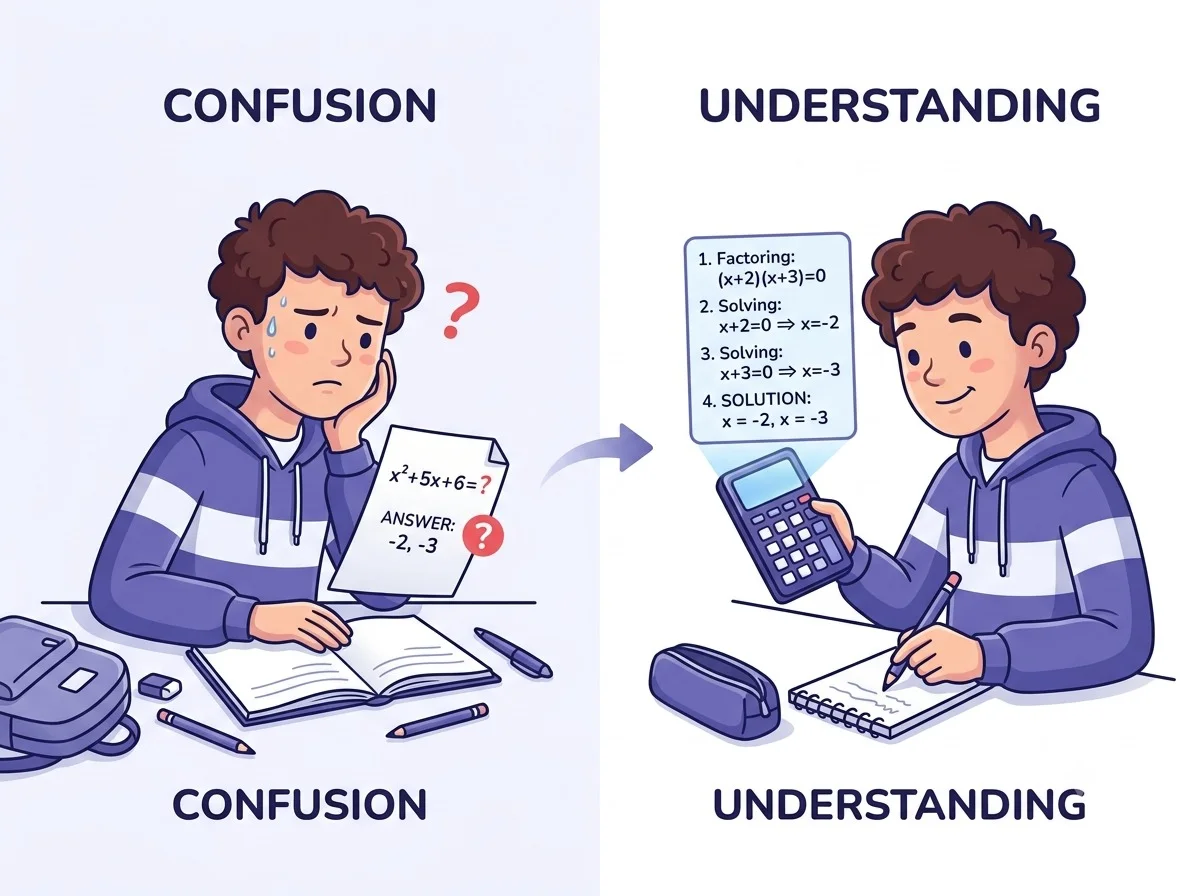
The Long Division Calculator goes through each step, without skipping around. The Fraction Calculator shows a simplified form next to the result, not only at the end. The Standard Deviation Calculator breaks down variance before you even get to the final figure. When you can see the process, it becomes easier to understand why the answer comes out the way it does, not just accept it.
Research from the University of Michigan found that students who used calculators with step-by-step explanations scored higher on conceptual math assessments than students who relied on answer-only tools. So no, it’s not “just” a shortcut. It’s the way you engage with the calculator that determines whether real understanding follows.
Math calculators tend to work best as tools for checking and learning support. Try the calculation by hand first, verify your work, and if the answers don’t match, trace the exact step where they diverge. That gap is where the actual learning shows up.
Frequently Asked Questions
When would I actually use an online math calculator? Any time you need a quick, accurate answer and arithmetic is not the point. Checking a sale price, scaling a recipe, verifying a test score, solving a geometry problem, or converting units these are all tasks where the calculation is a means to an end. An online math calculator handles the arithmetic so you can focus on the decision.
Are free online math calculators accurate? Yes, when they use standard formulas. Every calculator on this site applies verified mathematical formulas the same operations a physical scientific calculator or spreadsheet would perform. For standard arithmetic, percentage calculations, geometry, and statistics, results are exact or precise to multiple decimal places. For specialized tools like the AP Chemistry Score Calculator, results are estimates based on published scoring guides and may vary slightly from official scores.
Can a math calculator help me understand a topic, not just get the answer? A few of the tools here are made to show what they did, like Long Division, Standard Deviation, and Fraction calculations… they all show intermediate steps. Going over those step-by-step outputs beside your own work is one of the best ways to notice where your method drifts away from the proper way. In practice the calculator tends to shine more when you use it like a verification tool not as a full replacement for actually thinking through the problem.
What types of math calculations are covered? The 14 tools cover arithmetic (percentages, fractions, averages, long division), algebra (ratios, exponents), geometry (area, triangles), statistics (standard deviation), science applications (Punnett squares, Lbm to Lbf, AP Chemistry scores), and academic tools (grade curves, Roman numerals). If you need financial, health, or unit conversion calculations, those are in separate sections at EasyFreeCalculator.
Do I need to create an account or download anything? No, every tool is free, runs fully inside your browser, and works on phones tablets and desktops. There is no account , no download, no subscription. Put in your numbers and get a result right away.