📑 Table of Contents
- What Is a Financial Calculator and Who Needs One?
- How to Use a Financial Calculator: The Basics
- What Does PMT Mean on a Financial Calculator?
- What Is PMT in Finance, Exactly?
- Finance Charges Explained: Credit Cards and Loans
- How Do You Find a Finance Charge?
- IRR and Advanced Functions: For Business and Investment Decisions
- What Is IRR and How Does an IRR Financial Calculator Work?
- TI BA II Plus: The Gold Standard Physical Financial Calculator
- Online Financial Calculator vs. Physical Calculator: Which Should You Use?
- Business Financial Calculators: What to Look for
- Start Calculating Smarter Today

According to a 2024 National Financial Educators Council report, poor financial literacy costs the average American over $1,500 each year — mostly because loan terms get misunderstood, interest gets miscalculated, and payment schedules feel kinda unclear. A financial calculator helps with that fast. Like, whether you are sorting out a mortgage, judging a business investment, or just trying to decode the fine print on a credit card statement, knowing how to operate a financial calculator the right way gets clean numbers in front of you, in seconds.You do not need an advanced finance degree or an expensive physical device. Today, a free online financial calculator gives you the same computational power as the tools used by bankers and business analysts — with no sign-up, no software download, and no cost.
What Is a Financial Calculator and Who Needs One?
A financial calculator is like a specialized tool, designed to handle time value of money problems-those calculations that look at how money today connects to money later. It’s way beyond basic math, because it answers questions where timing matters. A regular calculator app may be fine for add, subtract, and multiply, but it usually doesn’t do the full “money over time” part. A financial calculator can help with things like “How much will I pay in total interest on this loan?” or “What monthly payment can I realistically afford?” or even “Is this investment worth it compared to that one?”
People use these tools when they’re stress testing options. For example, homebuyers running mortgage scenarios, small business owners checking whether a new machine is a smart purchase, students planning how student loan repayment might actually play out, and anyone who looks at a credit card statement and thinks, “Why does the minimum payment hardly reduce anything?”
Basically, most people have some reason to use one at some point. And once you add an advanced financial calculator into the mix, the numbers come out quicker, more precisely, and easier to interpret.
How to Use a Financial Calculator: The Basics
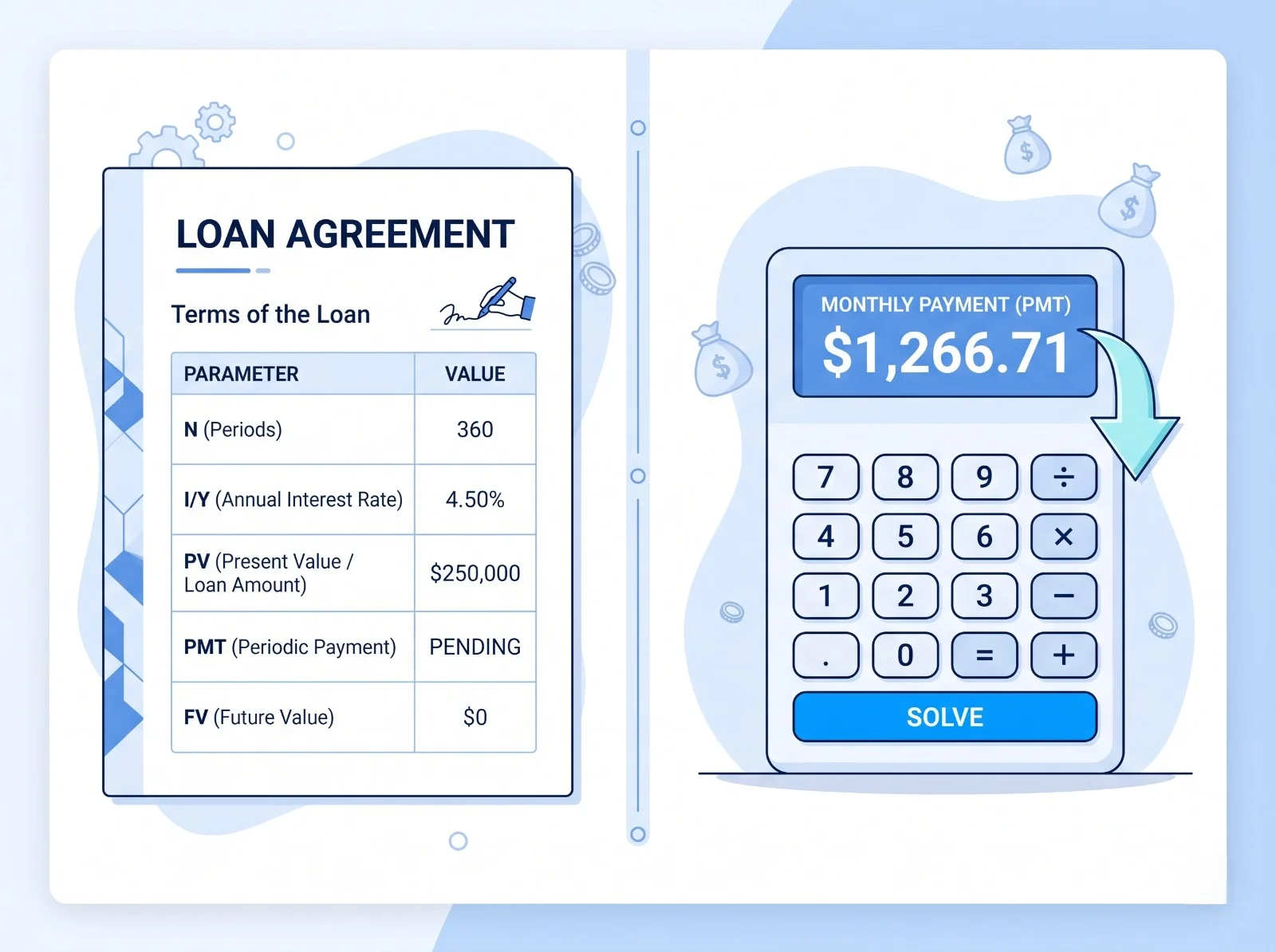
Most financial calculators whether they are physical units like the TI BA II Plus or free online versions-are built around five core variables. Those five inputs work together to solve nearly any standard loan or investment question. You plug in four values, and the calculator figures out the missing fifth.
- N is the total number of payment periods. Like, for a 30-year mortgage with monthly payments N = 360. For a 5-year car loan with monthly payments, N = 60.
- I/Y is the interest rate per period. If your annual rate is 6% and you are making monthly payments, enter 0.5 (6 divided by 12).
- PV is present value — the loan amount or the starting balance you are working with today.
- PMT is payment amount — the regular payment made each period, which we will cover in detail below.
- FV is future value — the balance remaining at the end of the loan term, or the target savings balance you want to reach.
Once you understand these five variables, using any financial calculator becomes straightforward. Enter what you know, and solve for what you need.
What Does PMT Mean on a Financial Calculator?
PMT stands for payment. On a financial calculator, PMT refers to the fixed, recurring payment made at regular intervals over the life of a loan or investment. It is one of the five core time value of money variables, and it is the one most people, kind of need to calculate first when they’re evaluating a loan, ya know.
For example if you borrow $20,000 over 5 years at a 7% annual interest rate, the PMT function, calculates what your monthly payment will be-around $396 in this case. Then you can tweak the loan amount, the duration, or the interest rate, to watch how the payment changes, and that’s basically what makes a loan calculator so useful for comparing offers before you sign anything.
What Is PMT in Finance, Exactly?
In financial terms, PMT represents an annuity payment — a fixed sum paid or received at equal intervals. The concept applies to mortgages, car loans, personal loans, lease payments, and even regular investment contributions. When a lender says your monthly payment is $X, they have already run the PMT calculation using your principal, interest rate, and loan term.
Understanding what PMT means on a financial calculator helps you reverse-engineer any loan offer. Instead of trusting a lender's quoted payment, you can input the numbers yourself and verify the math. If the lender's figure does not match your calculator, it is worth asking what fees or structures are built into their number.
Finance Charges Explained: Credit Cards and Loans
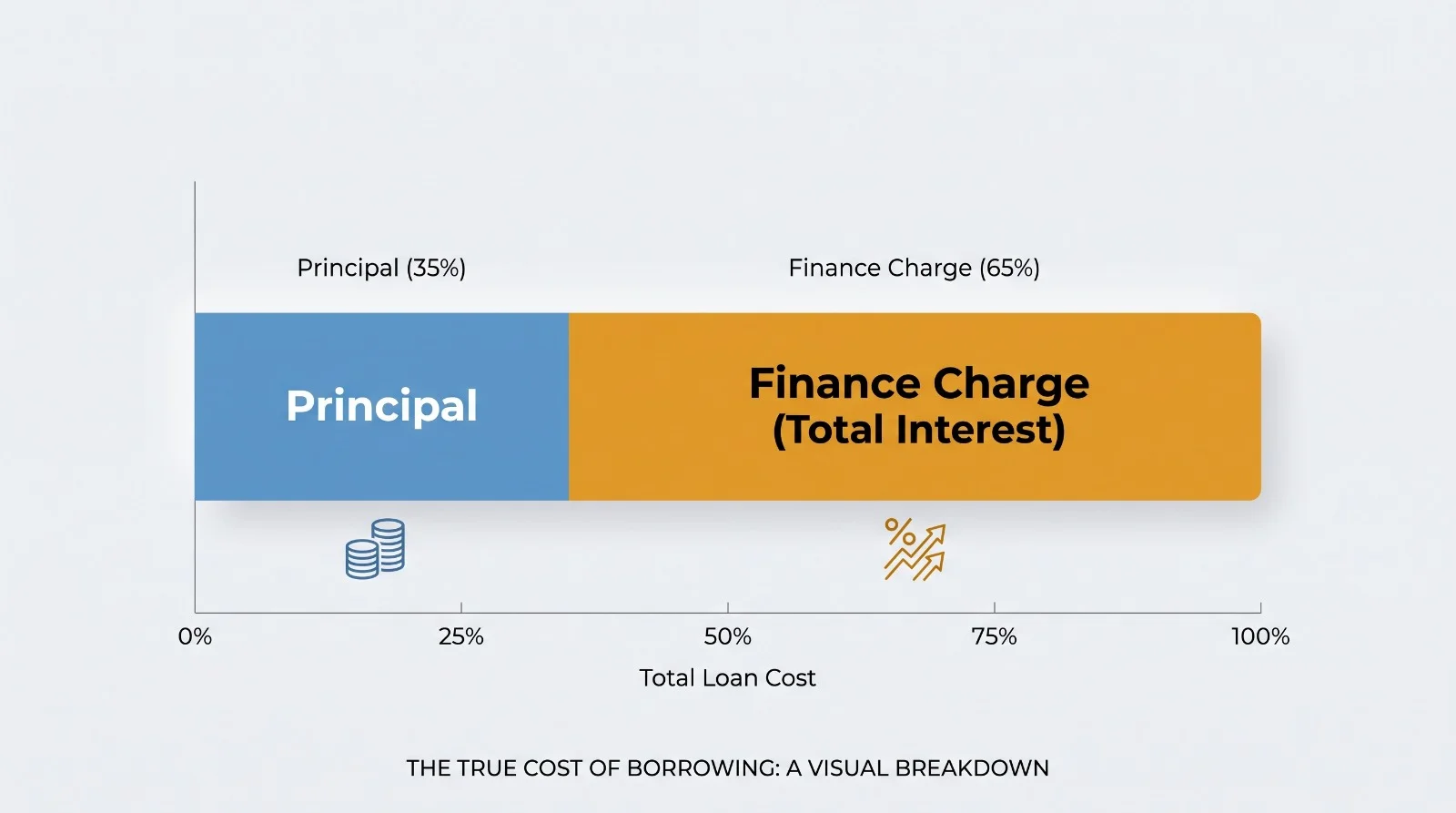
A finance charge is the total cost of borrowing money — expressed in dollars rather than as a percentage. It includes interest plus any applicable fees, and it is the number that tells you the true cost of carrying a balance or taking out a loan. Many people focus only on the interest rate without realizing how large the actual dollar amount of finance charges can grow over time.
On credit cards, finance charges can be kind of brutal because card issuers usually compound interest each day, with rates hovering around 20% to 30% APR. If you leave a $3,000 balance sitting there with a 24% APR for the whole year, it can shake out to about $720 in finance charges, even if you never do another purchase. A simple interest calculator can help you model these costs fast, so you get a clearer picture of the real cost of a revolving balance.
How Do You Find a Finance Charge?
It kinda depends on the account type. For most credit cards, the issuer figures it out by taking your average daily balance and multiplying it by the daily periodic rate (that is, your APR divided by 365), then multiplying again by the number of days in the billing cycle. For straightforward loans, the finance charge is basically just what you repay in total minus the original principal.
In real life, the quickest method is to plug your loan amount, interest rate, and repayment term into a financial calculator, then subtract the principal from the total repayment amount. That difference is your finance charge-the full dollar cost of borrowing.
IRR and Advanced Functions: For Business and Investment Decisions
Beyond basic loan calculations, financial calculators also handle more sophisticated investment analysis. This is where tools like an IRR financial calculator become essential for business owners, investors, and anyone comparing multiple financial options.
What Is IRR and How Does an IRR Financial Calculator Work?
IRR, usually meaning Internal Rate of Return, is that annualized percentage return which ends up making the net present value of a set of cash flows land right on zero, sort of speaking, so it’s basically a technical way to say it shows the effective yearly gain on an investment based on the purchase price and the cash it brings in over the years.
Take a business owner thinking about buying equipment for $50,000. Suppose it brings in $15,000 in net cash flow each year for five years, then the IRR comes out roughly 15.2%. Now if the business can obtain funding at 8%, the idea seems reasonable, because the return is higher than the cost of capital. But if the borrowing rate is 18%, then no, it doesn’t really make financial sense. An investment calculator helps model these scenarios quickly, so business decisions are grounded in actual math rather than gut feel.
IRR is particularly useful when comparing two investments with different cash flow profiles. The one with the higher IRR delivers a better return relative to its cost — all else being equal.
TI BA II Plus: The Gold Standard Physical Financial Calculator
When people search for a financial calculator by name, the TI BA II Plus comes up most often. It is the calculator approved for the CFA exam, widely used in finance courses, and trusted by professionals who prefer a physical device over an online tool. The financial calculator price for a TI BA II Plus typically runs between $35 and $55 depending on the retailer, and a professional version with additional features is available for around $70–$80.
The TI BA II Plus solves all five time-value-of-money variables, handles amortization schedules, and includes worksheets for depreciation, bond pricing, and break-even analysis. Learning to use it takes a bit of practice because the workflow involves storing values into memory registers rather than entering them all at once=but once mastered, it is extremely fast.
For most everyday financial calculations, however, a free online financial calculator emulator delivers identical results without any learning curve or upfront cost. The math is the same; the interface is simply more intuitive.
Online Financial Calculator vs. Physical Calculator: Which Should You Use?
The honest answer is that it depends on your situation. If you are studying for a finance exam or the CFA, you need to practice on the TI BA II Plus because that is the approved device. For everything else — personal financial planning, loan comparisons, mortgage research, investment projections — a free online tool is faster, more visual, and requires no manual entry into memory registers.
Online tools also tend to show results in a more readable format — displaying full amortization tables, month-by-month breakdowns, and visual summaries that a physical calculator's small screen cannot replicate. A finance calculator emulator built for the web gives you the same computational accuracy with a far better user experience.

Business Financial Calculators: What to Look for
For business use, financial calculators need to handle more than just loan payments. A strong bunch of business financial calculators should basically touch return on investment (ROI), internal rate of return (IRR), break-even analysis, and profit margin numbers alongside the usual loan and payment tools.
When you’re trying to decide which calculator suite to trust, check whether the tools are transparent about their own formulas, update results in real time as you tweak inputs, and don’t force you into making an account or paying some subscription fee. Accuracy really matters: a calculator that rounds wrong, or leans on simplified equations can end up being meaningfully off on larger loan balances, or over longer time horizons.
Start Calculating Smarter Today
Financial calculators remove the guesswork from some of the most consequential decisions people make — taking out a loan, carrying a credit card balance, investing in a business, or planning for retirement. Understanding what PMT means, how finance charges are calculated, and how IRR helps evaluate investments are not abstract concepts. They are practical tools that put you in control of the numbers before anyone else is.
Whether you are comparing loan offers, checking the true cost of a credit card balance, or projecting investment returns, a free online calculator gives you accurate answers in seconds. Explore the full suite of tools — including the loan calculator, investment calculator, and retirement calculator — all free, all instant, and no sign-up required.