📑 Table of Contents
- What Is Water Potential? Definition and Real-World Context
- Why Water Potential Matters in Plant Science and Agriculture
- The Water Potential Equation: How the Formula Works
- Osmotic Potential (Solute Potential)
- Pressure Potential
- Matric Potential (Advanced Applications)
- Water Potential Reference Chart: Component Values by Environment
- How to Calculate Water Potential: Step-by-Step
- How to Use the Water Potential Calculator
- Key Features of This Water Potential Tool
- Frequently Asked Questions About Water Potential
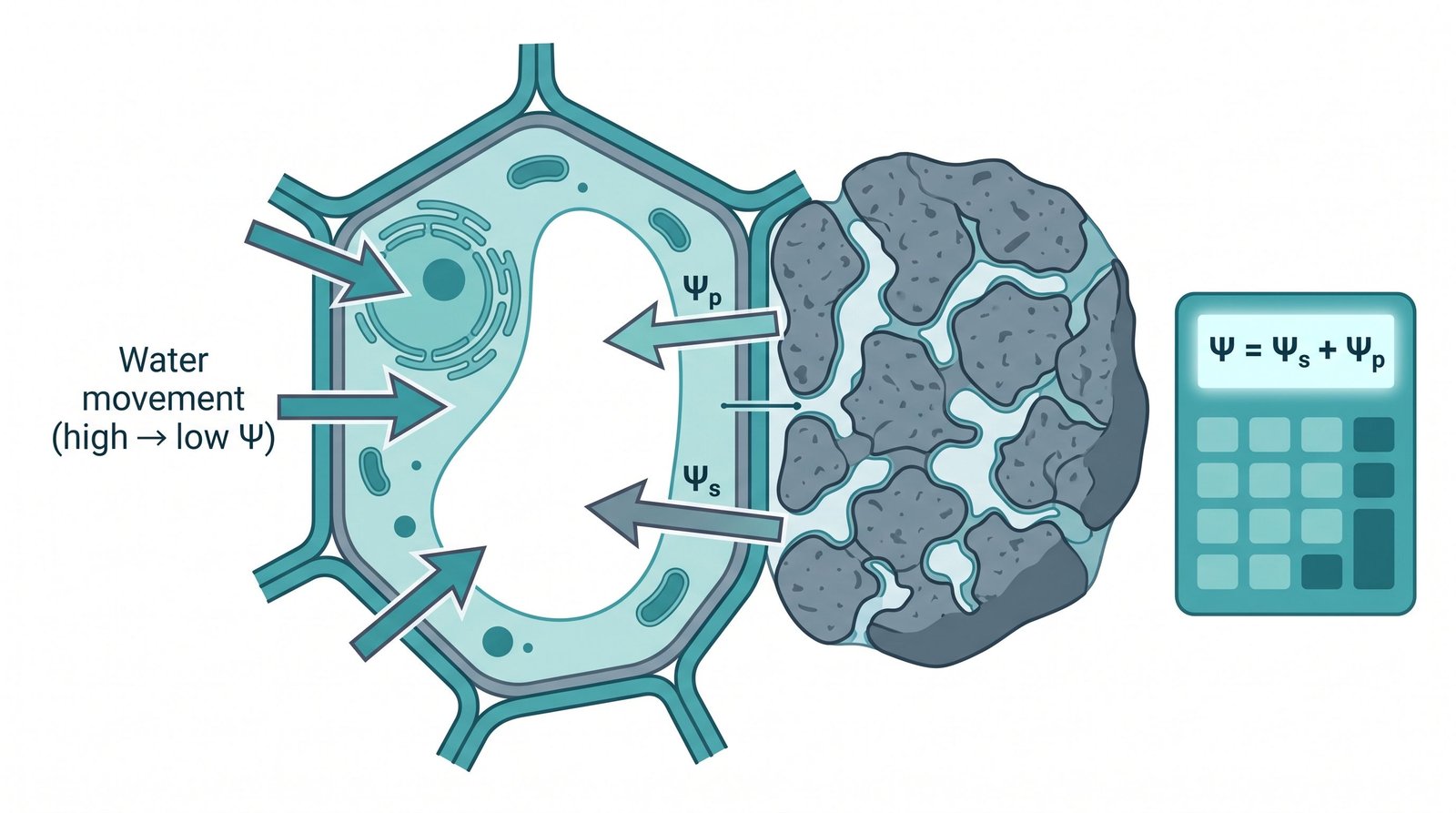
The transportation of water in plants, soil, and membrane cells does not happen through any pump or active transport but because of the water potential gradient. According to the USDA Agricultural Research Service, water potential gradient provides over 95% of all water transport through the plant tissue and is one of the most important parameters in plant physiology and agriculture. Free water potential calculator available on this page quickly calculates water potential by summing its main components – osmotic potential and pressure potential based on the thermodynamic formula. This article will help students and specialists in biology and agriculture to understand the water potential calculation formula, components, and calculator usage.
What Is Water Potential? Definition and Real-World Context
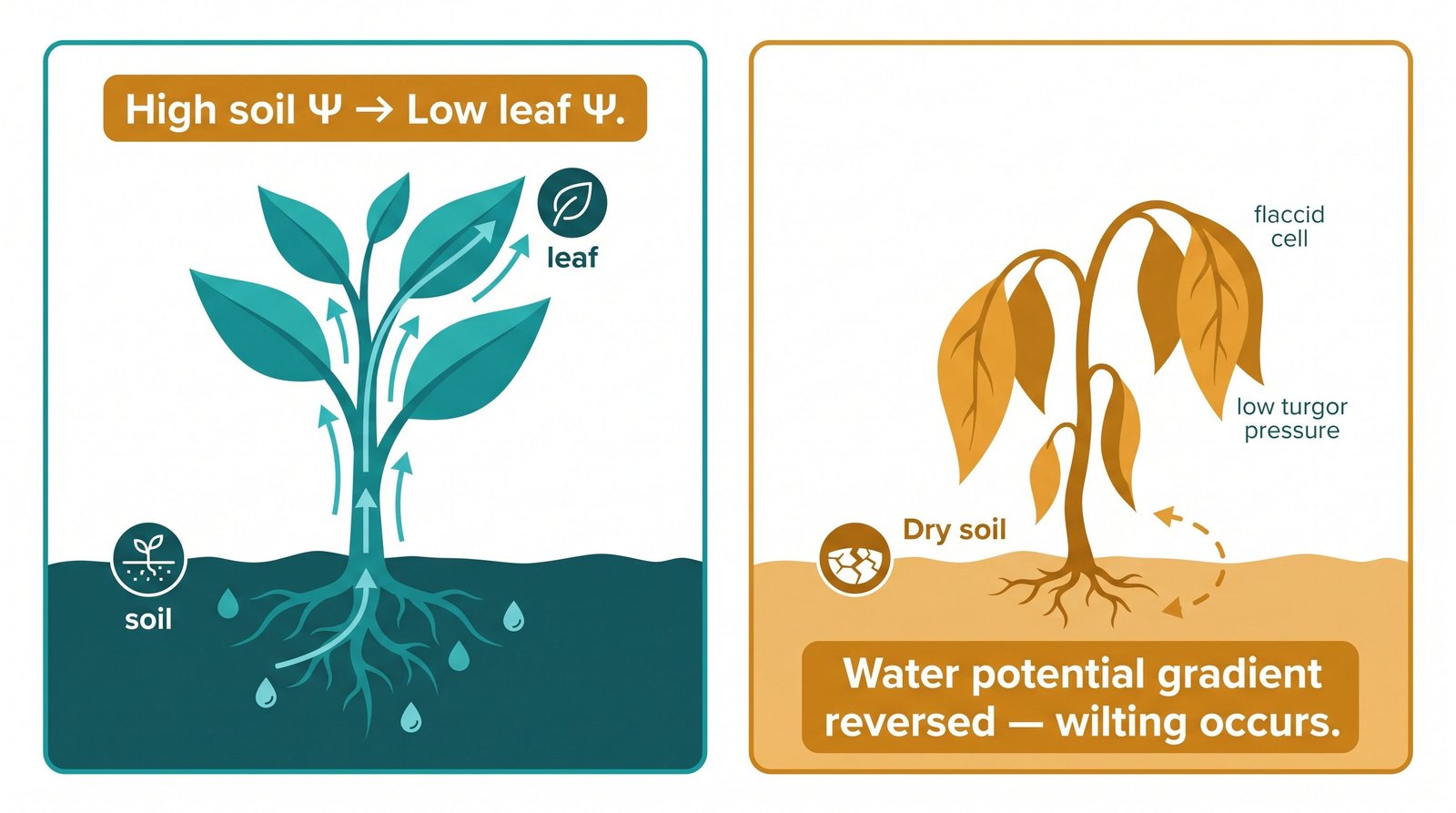
Water potential (symbol Ψ; pronounced 'psi') is used to measure water energy in a given system; it refers to the water molecules' tendency toward a particular location. Water always travels from the area of high water potential to that of low water potential. In living organisms, water usually travels from soil to roots of plants, from there to the stem, and then to the plant's leaves; the whole process is called transpiration.
Pure water at atmospheric pressure will have a water potential of 0 megapascals (MPa), which acts as the zero value. All other water potentials are expressed relative to this baseline. Water with dissolved solutes has a negative water potential the solutes reduce the free energy of the water molecules. Water under positive physical pressure has a higher (less negative) water potential.
The unit for water potential is megapascal (MPa), although in the old literature, bars are also used (1 MPa = 10 bars). (For related volumetric conversions such as litres to cubic meters, use our volume converter). The water potential of well-watered plant leaves will usually be in the range of −0.2 to −1.0 MPa. If there is drought, leaf water potential may go down to −2.0 MPa or below, which is the stage where most crops begin to incur losses in yield.
Why Water Potential Matters in Plant Science and Agriculture
In crop management, water potential measurements guide irrigation scheduling. According to FAO, more than 40% of the total global crop losses arise due to water stress, either of inadequate amounts or poor management of water. The calculation of water potential helps in knowing the amount of irrigation required.
In plant physiological experiments, the study of water potential is important for drought resistance, osmotic adjustment, and interpretation of data in experiments carried out by means of pressure chamber and osmometer. In soil science, the water potential (especially matric potential) is important for water availability to plant roots.
In the cellular context, cell expansion is driven by water potential in the process of growth. During the growth of a cell, the cell creates a negative osmotic potential through accumulation of solutes, drawing water in and increasing the turgor pressure (positive pressure potential). This is the balance between these two factors that leads to cell expansion. Knowledge of the water potential of plants is therefore crucial in understanding the physiology of plants and their agricultural efficiency.
The Water Potential Equation: How the Formula Works
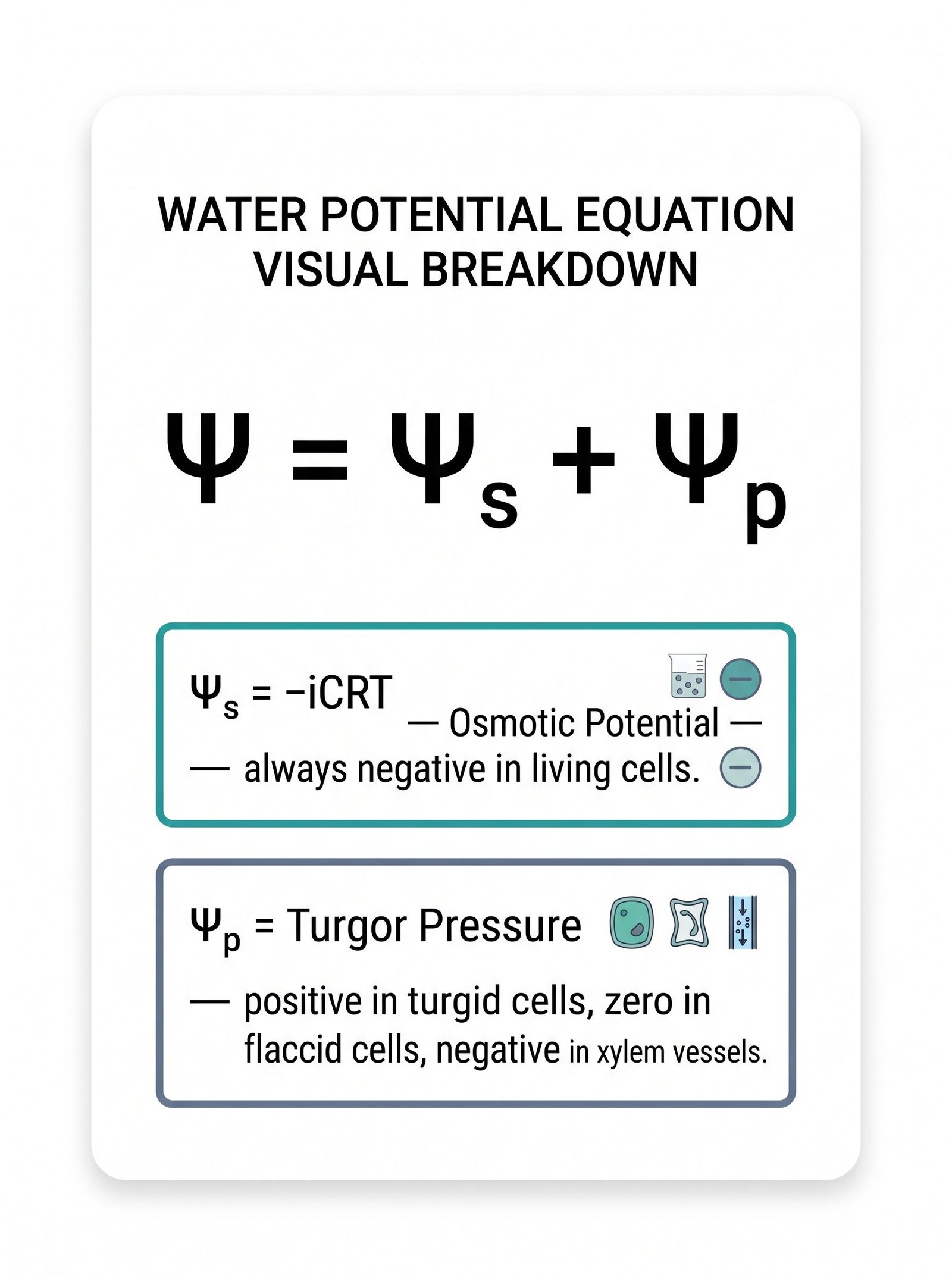
The basic equation of water potential in plant and soil science is as follows: Ψ = Ψs + Ψp. Water potential is equal to osmotic potential plus pressure potential. When using the equation in some complicated situations in soil science, an additional parameter of matric potential (Ψm) is used: Ψ = Ψs + Ψp + Ψm. Each of these parameters evaluates a different physical component contributing to the free energy of water.
Osmotic Potential (Solute Potential)
The osmotic potential (Ψs) refers to the influence of dissolved substances on the overall water potential. It is always zero or negative because solutes always reduce the free energy of water. The van 't Hoff equation gives the formula: Ψs = −iCRT, where i is the ionization constant of the solute, C is the molar concentration (mol/L), R is the gas constant (0.00831 L·MPa/mol·K), and T is the temperature in Kelvin.
The osmotic potential of 0.1 M sucrose at 25°C is: Ψs = −(1)(0.1)(0.00831)(298) = −0.248 MPa. In addition, the osmotic potential of 0.1 M NaCl at the same temperature is: Ψs = −(2)(0.1)(0.00831)(298) = −0.495 MPa. With a calculator, the process will be easier because you can put your data including concentration, ionization constant, and temperature.
Pressure Potential
Pressure potential (Ψp) is the physical pressure exerted on water within a system. In turgid plant cells, turgor pressure is positive the cell wall pushes back against the water inside, increasing the cell's water potential and preventing further net water uptake. In wilted cells, pressure potential approaches zero. Pressure potential in xylem vessels (channels conducting water in plants) can be negative due to the rapid transpiration process and hence produce the tension required to lift up water upwards.
Pressure potential is determined by a pressure probe (individual cell measurement) or pressure chamber (also known as pressure bomb) in case of whole leaf. The values are usually from +0.5 to +2.0 MPa in turgid cells and from -0.5 to -2.5 MPa in xylem. There is an additional pressure potential calculator option in the same calculator that will allow isolating this component.
Matric Potential (Advanced Applications)
Matric potential (Ψm) is the attraction of water to the surfaces such as cell wall and soil particles and pores. It can never be positive and is very crucial in soil science since it shows how the soil holds water. The matric potential equals zero in free water and may go down to -100 MPa or lower. For most biological calculations in plants matric potential is not considered in cells and is used only in soil water potential.
Water Potential Reference Chart: Component Values by Environment
Here is the table of major water potential components, their symbol, typical values and physical meaning. Use it when interpreting your calculations or laboratory results.
| Component | Symbol | Typical Range | What It Represents |
|---|---|---|---|
| Total Water Potential | Ψ | −5 to 0 MPa | Net tendency of water to move |
| Osmotic Potential | Ψs | −3 to 0 MPa | Effect of dissolved solutes |
| Pressure Potential | Ψp | 0 to +3 MPa | Physical pressure on water |
| Matric Potential | Ψm | −5 to 0 MPa | Adhesion to soil/cell walls |
| Gravitational Potential | Ψg | Varies with height | Effect of gravity on water column |
| Pure water (reference) | Ψ | 0 MPa | Baseline — all potentials relative to this |
How to Calculate Water Potential: Step-by-Step
The proper calculation of water potential is possible only by recognizing the components that exist in your problem and using the appropriate values. Here is how a typical plant biology problem is solved using water potential.
Scenario: There is a 0.3 M sucrose solution (non-ionizing, i = 1) inside a plant cell at 25°C. There is a turgor pressure of 0.7 MPa inside the cell. Determine the value of the water potential.
- Step 1 - Calculation of osmotic potential: Ψs = −(1)(0.3)(0.00831)(298) = −0.743 MPa
- Step 2 - Pressure potential determination: Ψp = +0.7 MPa (turgor pressure)
- Step 3 - Application of the water potential formula: Ψ = Ψs + Ψp = −0.743 + 0.7 = −0.043 MPa
Thus, in this case water potential is −0.043 MPa. Since the surrounding solution (pure water, Ψ = 0 MPa) has a higher water potential, water would still flow into the cell though at a very slow rate given the small potential difference. This is the equilibrium point.
How to Use the Water Potential Calculator
- Step 1: Select your calculation type simple (Ψs + Ψp) or advanced (Ψs + Ψp + Ψm for soil applications).
- Step 2: Enter your osmotic potential values. In the case of van ‘t Hoff method, input the concentration of the solute in mol/L, ionization constant i, and temperature in degree Celsius/Kelvin. The water potential calculator converts units automatically.
- Step 3: Enter the pressure potential value in MPa. Use positive values for turgor pressure, negative values for xylem tension, or zero for a flaccid cell.
- Step 4: If using advanced mode, enter the matric potential value in MPa (typically measured from a soil water characteristic curve).
- Step 5: Click Calculate. This gives total water potential in MPa, shows contributions of each of the components and the direction of water flow relative to pure water.
Key Features of This Water Potential Tool
- Van 't Hoff integration: Use the actual value of solute concentration; the calculator uses van 't Hoff integration behind the scenes.
- Temperature correction: The user must input the given temperature in degrees Celsius, as the calculator will handle converting to Kelvin.
- Multiple modes: There are two options available for the calculation: one relies on the two-variable method (Ψs + Ψp), while the other uses a three-variable (Ψs + Ψp + Ψm) approach.
- Instant results: The calculator is ready to show results with no wait time.
- Free, no registration: The water potential calculator is permanently free. No registration, no payment needed.
- Mobile friendly: Works on phones, tablets, and desktops.
There are several ways to calculate water potential, but it still serves as a basis for practically all processes in plant physiology, soil studies, and agriculture. It is the formula, along with its sign convention and the correct choice of units, where the manual calculation usually goes wrong. The water potential calculator does the math correctly and delivers results in the scientific units. All tools are permanently free at EasyFreeCalculator.
FAQs
The water potential of pure water under normal pressure and temperature conditions is exactly 0 MPa. It is taken as the reference state for calculating other water potentials. Solutes decrease it to less than zero (osmotic potential is negative), while positive pressure increases it to more than zero. Pure water is the highest possible value of water potential.
Calculate by the equation Ψs = −iCRT and then add pressure potential: Ψ = Ψs + Ψp. Here i = van 't Hoff factor (number of particles that solute dissociates to), C = molarity in mol/L, R = gas constant 0.00831 L·MPa/(mol·K), T = temperature in Kelvin (°C + 273). The water potential calculator does this calculation using your input data on concentration and temperature.
Water potential is measured in megapascals (MPa) and bars (1 MPa = 10 bars). MPa is the unit of measurement used in modern scientific works. There is an old terminology where bars and atmospheres (atm) are used: 1 atm ≈ 0.101 MPa. The calculator uses only megapascals because of the modern scientific tradition and instrument calibration.
The smaller the value of the water potential, the lesser is the free energy of the water molecules. They have a tendency to move less spontaneously and accept water from areas having greater water potential. The water potential of cells having a value of −0.8 MPa will get water from a solution whose water potential is −0.2 MPa.
The term osmotic pressure refers to the pressure that stops osmosis from occurring, as well as being a positive factor, but also serves to prevent the flow of water. Osmotic potential is the impact of dissolved solutes that either has a value of 0 or that is negative. They describe the same phenomenon from opposite directions. Osmotic pressure equals osmotic potential. Osmotic potential (as negative values) is now in use and helps to keep a uniform framework for the concepts associated with water potential.