📑 Table of Contents
- What Is the Period Calculator?
- How to Use the Period Calculator
- How the Calculation Works
- Calculating Your Next Period Date
- Checking If Your Period Is Late
- Understanding Average Period Length and Cycle Length
- Menstrual Cycle Reference Table
- Key Features of This Period Tracker
- Why Use This Tool?
- Use Cases: When People Use a Menstrual Cycle Calculator
- Planning and Preparation
- Checking a Potentially Late Period
- Health Tracking Over Time
- Frequently Asked Questions About the Period Calculator
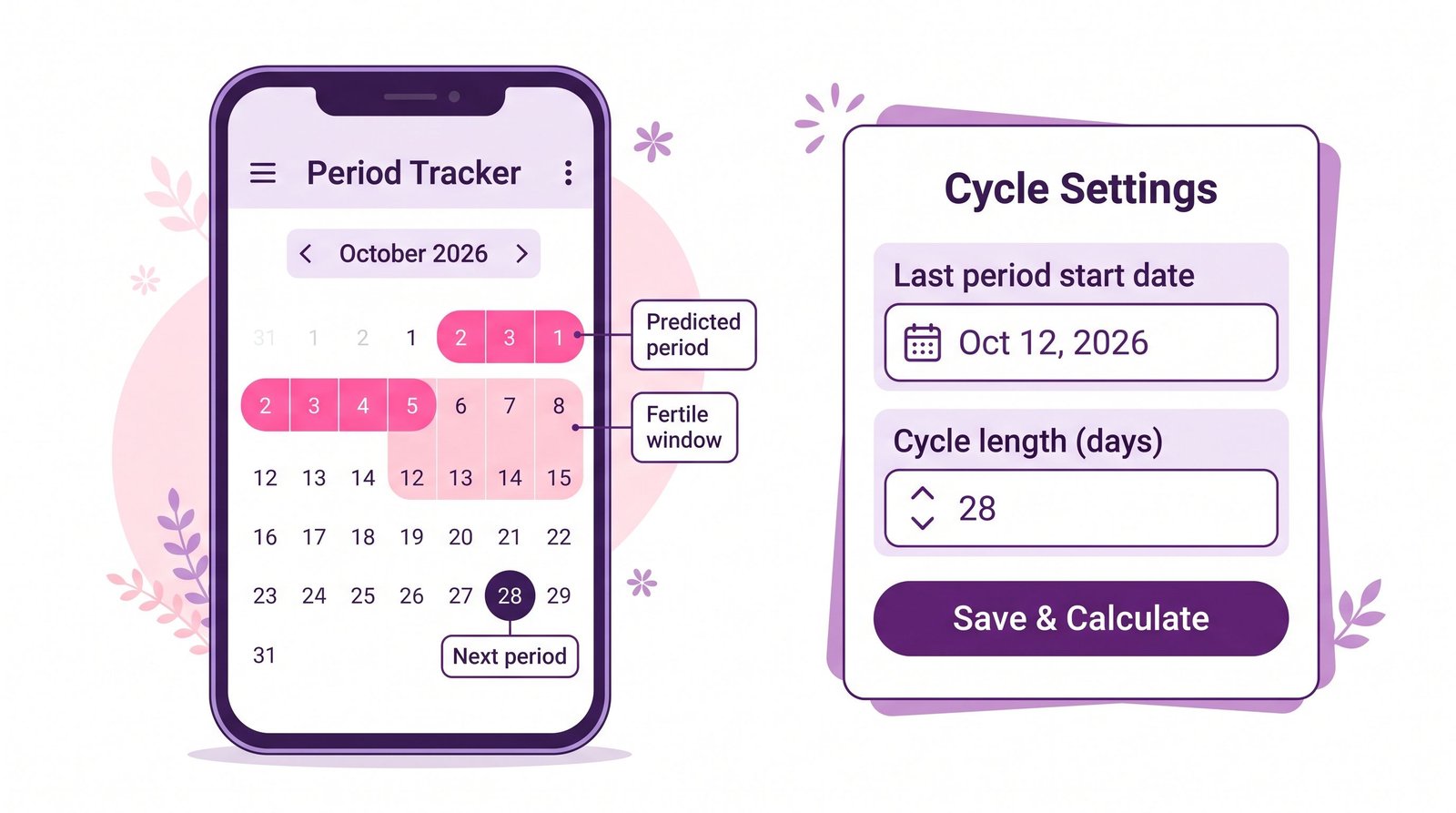
Learning your menstrual cycle begins with knowing when it’s going to come. The period calculator is a convenient and easy-to-use resource that answers all your cycle-related questions. Input the date of your last period, as well as the length of a typical cycle, and the tool estimates when your next period will occur, tells you if your period is running behind schedule, and projects what your cycle will look like for months into the future. A study conducted in 2019 that utilized over 600,000 menstrual cycles demonstrated that menstrual cycle length is unique to every person, typically lasting between 21 and 35 days, meaning an estimation based on the traditional 28 days will not be accurate for an individual.
This page explains how the period calculator works, how to use it, and what the results mean.
What Is the Period Calculator?
A period calculator allows you to enter your last period date and typical cycle length to predict your next period. It can also tell you if your period is late based on how many days have passed since your expected start date.
This period calculator combines menstrual cycle tracking with cycle tracking and period calendars in one. You enter your data, and it returns a personalized period timetable a forward-looking schedule of expected start dates based on your logged cycle length. This calculator is a huge improvement on the standard 28-day period calendars that women used to have to rely on.
This calculator cannot diagnose conditions that lead to cycle irregularities. If your cycle is always irregular or you have questions about changes, see your GP or a gynecologist.
How to Use the Period Calculator
- Step 1: Enter the date your last period started. This is Day 1 of your most recent cycle, the first day of actual bleeding, not spotting.
- Step 2: Enter your average cycle length. This is the number of days from the start of one period to the start of your next period. 28 days is the default, but you should know your average.
- Step 3: Enter your average period duration-how many days your period typically lasts. This affects how the tool highlights period days versus non-period days in the calendar view.
- Step 4: Click Calculate. This will generate your predicted next period date and how many days it is until your period is due and provide a calendar of your cycles in the future.
- Step 5: Review the generated output. Explore the period calendar to view predicted dates. Change the input data as required to regenerate the period calendar.
How the Calculation Works
The next period calculator employs a simple date formula to determine a period’s start date: Next Period = Previous Period Start + Cycle Length. Let's say your last period started on the 1st of the month, and your cycle length is 30 days. Your period is predicted to start again on the 1st of the next month.
The date calculator performs simple date subtraction to find the difference between two dates. (You can also compare timelines using an age calculator for exact date spans). This type of calculator is applicable for all general-purpose date calculations. The period calculator is a specialized calculator that applies this logic to determine menstrual cycle dates by iterating through multiple cycles.
Calculating Your Next Period Date
To determine the next period date, add the cycle length to your previous start date. Next Period = Previous Start Date + Cycle Length. To calculate period days within that cycle, the tool adds the period duration: Period Ends = Next Period Start + Duration − 1. A 30-day cycle with a 5-day period starting on 1 July would show period days from 1 to 5 July, with the following cycle beginning on 31 July.
For each subsequent cycle, the same addition repeats. The tool applies it automatically to produce the full forward-looking period calendar without any manual arithmetic.
Checking If Your Period Is Late
The late period calculator function compares today's date to the expected period start date. The predicted start date of the period is considered late if it exceeds five days from the current date. For example, if today’s date is March 10th and your predicted period date is March 5th, your period is one day late. The prediction threshold for lateness was set by the American College of Obstetricians and Gynecologists for clinical purposes.
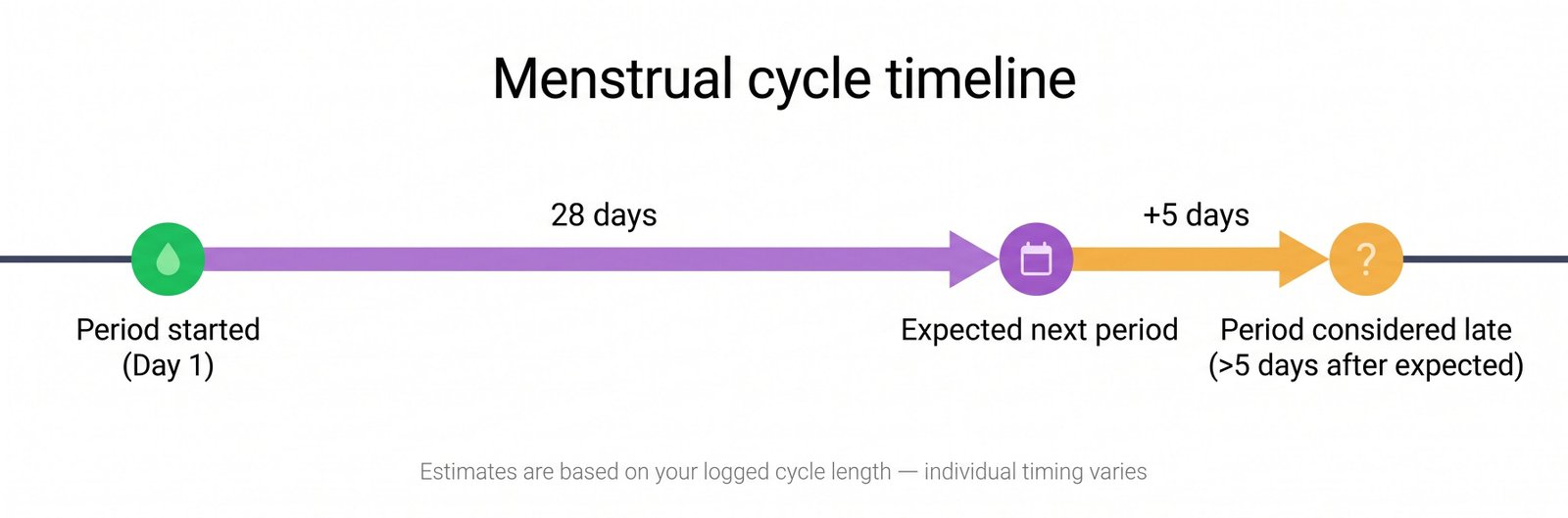
A period is not necessarily a symptom of an illness or a pregnancy. In fact, many factors affect the length of the period, including exercise, stress, change of weight, travel, etc. The lateness prediction should not be taken seriously, as there are no definite causes. Should a significant delay occur, you can take a pregnancy test or contact a doctor. For a better pregnancy prediction, you can take advantage of our pregnancy due date calculator.
Understanding Average Period Length and Cycle Length
A period cycle length is counted from the first day of a period to the first day of the next. Knowing this is important when calculating cycle length to track it or when comparing it to national or published averages.
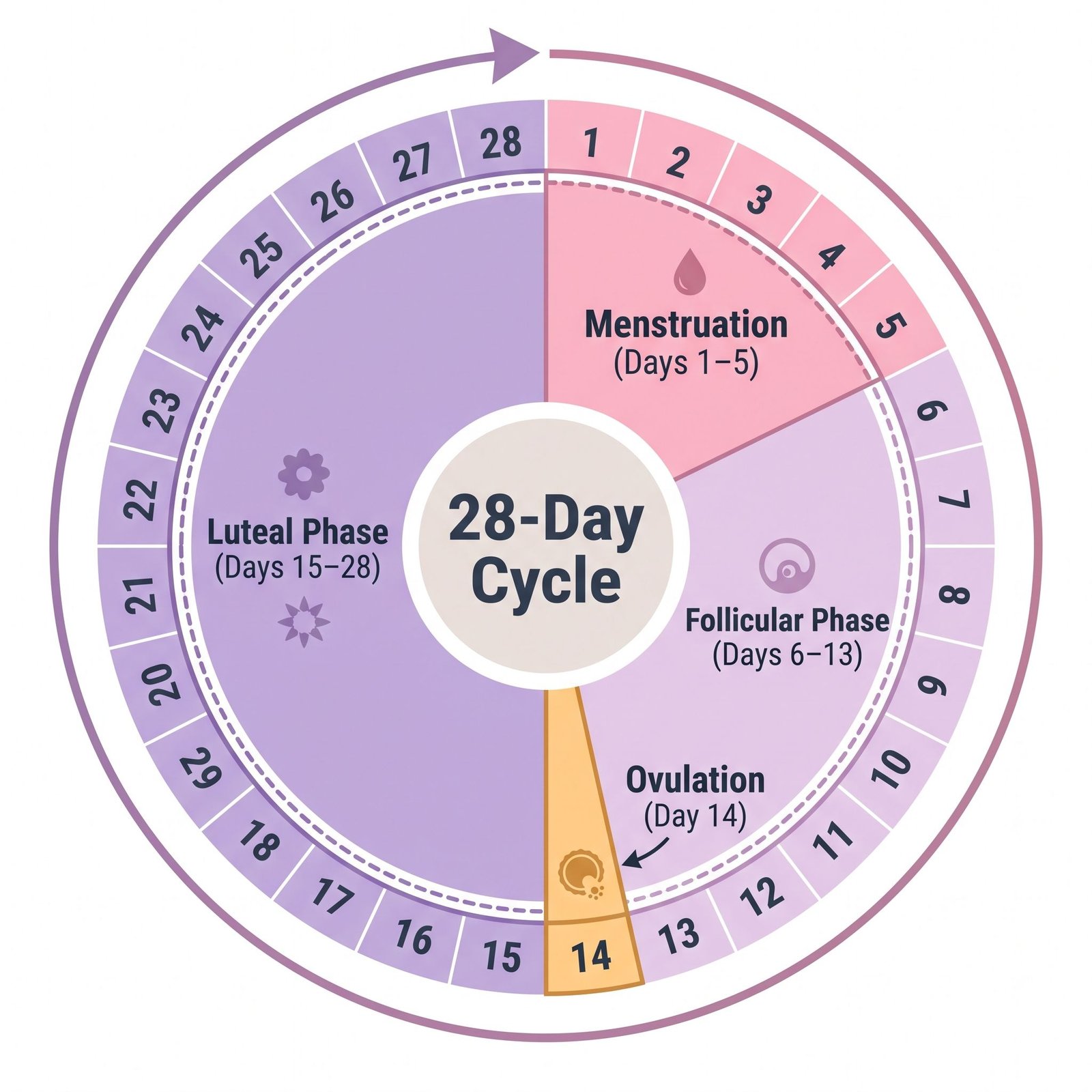
There are 4 parts to a cycle: menstruation (the period), the follicular phase (the time before ovulation), the time of ovulation, and the luteal phase (the time between ovulation and the start of the next period). The luteal phase is usually between 12 and 16 days. The follicular phase is more variable, which is causes the overall cycle length to vary from person to person and month to month.
Menstrual Cycle Reference Table
The values provided in this document are the standard values in the ACOG Clinical Guidelines and the NHS reference materials for reproductive-age adults. Individual cycles vary significantly; values outside these ranges are not necessarily abnormal.
| Cycle Variable | Typical Range | Average | Notes |
|---|---|---|---|
| Cycle length | 21–35 days | 28 days | Day 1 = first day of period; next period = Day 1 of new cycle |
| Period duration | 2–7 days | 4–5 days | Varies by individual and may change over time |
| Average flow | 30–80 mL total | ~40 mL | Flow measured over full period; varies by individual |
| Luteal phase length | 10–16 days | 14 days | Phase between ovulation and next period; most stable part of cycle |
| Follicular phase | 7–21 days | 14 days | Variable length; affected by stress, illness, lifestyle |
| Ovulation timing | Day 11–21 | Day 14 | In a 28-day cycle; earlier or later in longer/shorter cycles |
| 'Late' threshold | More than 5 days past expected | — | ACOG; occasional variation is normal |
| Irregular cycle range | Outside 21–35 days | — | Worth discussing with a GP if consistently outside this range |
Important: This table shows typical values from published clinical guidelines. Individual variation is normal and significant. A cycle that falls outside these ranges on one occasion is not necessarily a cause for concern. If your cycle is consistently irregular, unusually long, or associated with other symptoms, a GP or gynecologist is the appropriate resource.
Key Features of This Period Tracker
- Next period date prediction: Calculates your next expected start date from your last period and cycle length.
- Late period check: "Is my period late?" The calculator function shows how many days past your expected date you currently are.
- Multi-cycle calendar: The period tracker calendar shows upcoming predicted period dates for the next several months, not just the next one.
- Personalized cycle length: Works with any cycle length between 21 and 45 days, not a fixed 28-day assumption.
- Period duration tracking: Enter your typical period length to see period days highlighted separately from the overall cycle.
- Free, no account: This free period tracker requires no sign-up, stores no personal data, and works entirely in your browser.
- Mobile compatible: Works on phones, tablets, and desktops, and is accessible from any device.
Why Use This Tool?
With a standard calendar, you get an overview of what the current day is. Period calendars show you how far along in your cycle you are. This difference is useful for organizing the everyday schedule, as well as for a deeper understanding of one's body and noticing any changes.
Period tracking apps frequently request an account, health information, and permission for sending notifications. This menstruation calculator requires none of that. You enter a start date and a cycle length, and the tool generates your period timetable immediately nothing stored, nothing shared.
A quick starting point is provided to individuals who track their cycle for the sake of health. Showing a GP or a gynecologist a calendar on a printed sheet or screen offers them accurate data. Long-term period tracking also reveals your individual cycle average, thereby helping to improve the precision of the calculator.
Use Cases: When People Use a Menstrual Cycle Calculator
Planning and Preparation
Knowing your period is about three days away helps you plan events and appointments. Most people will look up a cycle tracker before any important date that could possibly conflict. In the case of this tool, cycle trackers have a feature that displays dates for the next few cycles as a sort of master schedule for planning longer into the future.
Checking a Potentially Late Period
The primary purpose of the period prediction results for the user is to determine how many days their current cycle has exceeded the expected duration. The calculator gives the number of days a cycle has run late relative to the cycle’s projected end. In this scenario, users can use that number of days to gain further insight into the situation. The pregnancy test may be worth a consideration if your cycle has been 5 days or longer.
The tool handles this straightforwardly: if today's date is past the predicted date, the result section shows 'Your period is X days late' alongside the expected date it was due. How to calculate a missed period is simply today's date minus the expected start date.
Health Tracking Over Time
Consistently tracking cycle length month by month is one of the most practical ways to notice if something changes. A cycle that was reliably 28 days and suddenly becomes 21 or 35 days is worth noting and worth mentioning to a doctor if the pattern continues. The menstruation tracker function provides a historical record when you log each cycle's start date, so you build a picture of your average cycle length over time rather than estimating from memory.
Many cycle tracking users utilize cycle tracking in combination with other health trackers. This has the effect of making observation a simpler and organized task. The cycle tracker does not provide any medical tracking functions; it is just a date calculator, but because of how it is organized, users can record other observations and draw links that would not have been easily visible without some other form of structure.
To see the date of your next period, you can use the free period calculator provided on this page. Simply input the start date of your last period and the length of your cycle, and the calculator will give you your very own personalized period schedule. No account creation and no data storage. Accessible via EasyFreeCalculator on any device.
This site is meant to be educational in nature. This site is not a medical service, and its information should not be used to make health decisions.
FAQs
Add your cycle length (in days) to the first day of your last period. If you had your last period on March 5th and have a 28-day cycle, your next period should be on April 2nd. If your cycle is 30 days, then it would be April 4th. The period calculator does this arithmetic automatically and repeats it forward for the next several cycles.
A period is generally considered late when it has not started within 5 days of the predicted date, according to ACOG guidelines. The late period calculator shows how many days past your expected date you are. Occasional fluctuation within a couple of days is normal. If your period is more than two weeks late, or you have a persistent irregular pattern, it’s a beneficial idea to talk to a healthcare provider.
A late period is not necessarily a sign of pregnancy. Some of the possible reasons are stress, drastic changes in body weight, sickness, overexertion, hormonal imbalance, or irregular periods, which are just naturally inconsistent. If your period is late by more than a week, then a pregnancy test will provide you with a definite answer. Consult your doctor about potential causes if your periods are late and you are not pregnant.
Identifying the first day of a missed period, a woman can count four weeks from this date. Pregnancy is calculated with reference to one’s last menstrual period, not conception day. So missing your period at the end of Week 4 means you may be 4–5 weeks along. A pregnancy due date calculator will give you a more accurate estimate based on the date of your last period.
The calculator shows your estimated cycle and can indicate the approximate timing of your fertile window based on cycle length. However, this estimate is not reliable as a method of contraception. Although menstruation cycles differ from person to person, individuals may have regular cycles but not necessarily ovulate on the predicted days. If someone intends to use this method for planning pregnancies or contraception, it is advisable to consult a professional.
The accuracy of any period estimator depends on the accuracy and consistency of your cycle length. If your cycles are regular and your logged cycle length reflects your actual average, predictions will typically be close. If your cycles vary, which is normal and common, actual period dates may differ from predictions by several days. The calculator uses the most recent start date you provide each time; therefore, by keeping your inputs up to date, you can ensure the accuracy of your results.