📑 Table of Contents
- What Are PSI and GPM? Definitions and Real-World Context
- Why PSI and GPM Are Not the Same Thing — and Why That Matters
- The PSI to GPM Formula: How the Conversion Actually Works
- Converting GPM to PSI: The Reverse Formula
- GPH vs GPM: When to Use Gallons Per Hour
- PSI to GPM by Pipe Size: A Practical Reference Chart
- How Many GPM Can a ½" Pipe Flow at 60 PSI?
- Pressure Washers and Nozzle Size: PSI to GPM in Action
- Who Uses a PSI to GPM Calculator and When
- How to Use the PSI to GPM Calculator on This Site
- Key Features of This Flow Rate Calculator
- Frequently Asked Questions About PSI to GPM Conversion
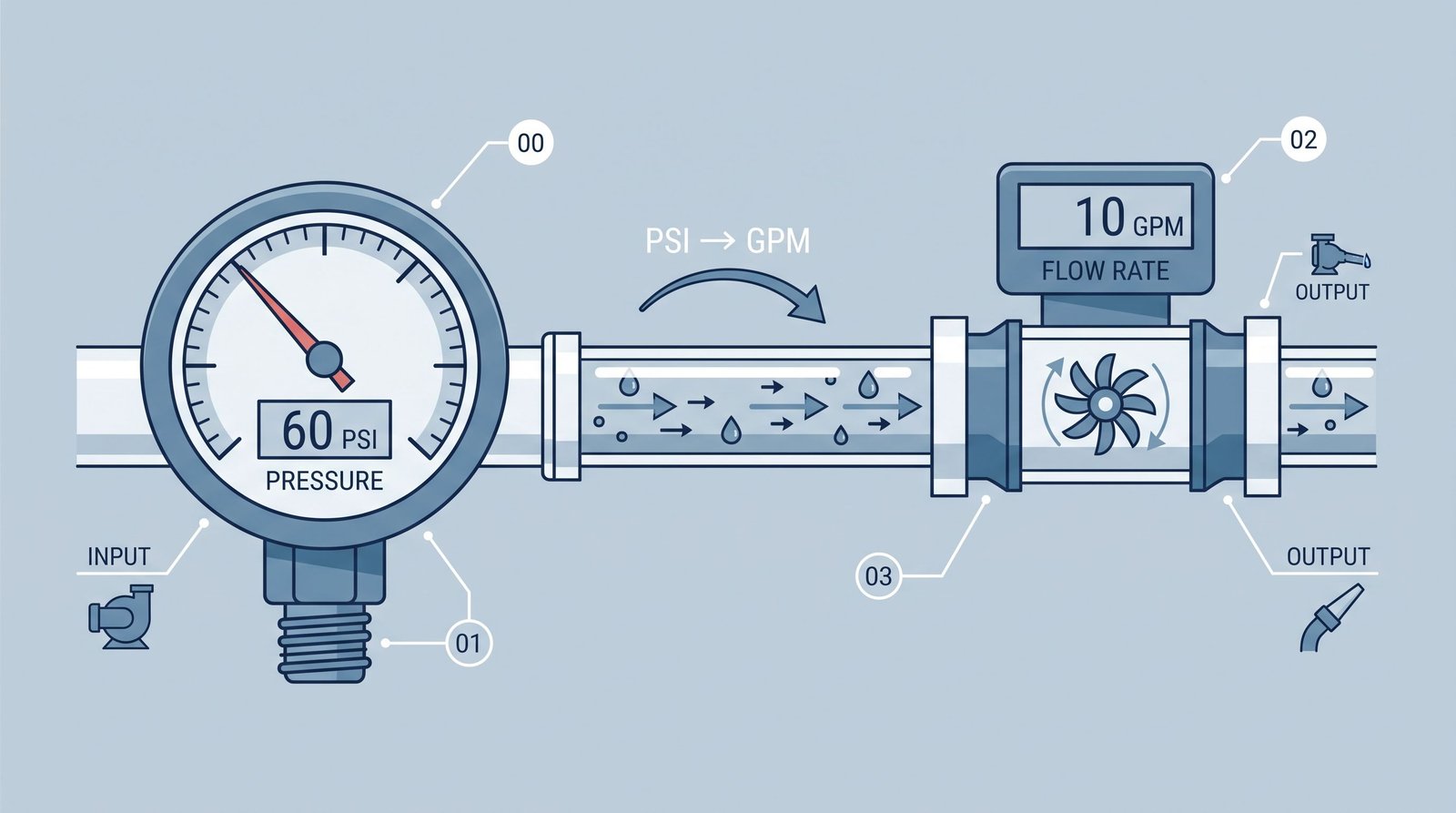
Water pressure and water flow are different things. They are related to each other, but mixing up the two is the most frequent and expensive mistake made in the field of plumbing, irrigation systems, and industry design. PSI stands for pounds per square inch and represents the force of the water pushing on the surface or pipes. GPM stands for gallons per minute and refers to the water flow. The US EPA estimates that inefficient water systems lose between 14% and 44% of their output to poor pressure-flow management, often because the relationship between PSI and GPM was never properly calculated. The free PSI to GPM calculator on this page converts between pressure and flow rate instantly, using your pipe size and pressure input to give you an accurate flow estimate.
This paper discusses what are PSI and GPM, how the formula works for the conversion, where pipe size and flow charts fit into the equation, and who would use this formula and for what reason. If all that matters is getting the answer, go straight to the calculator; otherwise, keep reading.
What Are PSI and GPM? Definitions and Real-World Context
PSI stands for pounds per square inch. PSI is a pressure unit which means one-pound force acting on rectangular inch area. For residential water system in the USA, standard water tap pressure is around 40 to 80 PSI. Most of the municipalities supply water at a standard pressure of 60 PSI at the meter. While a normal pressure washer operates between a range of 1500 – 4000 PSI, industrial hydraulic systems work beyond 10000 PSI.
GPM means gallons per minute, which is the measure of how much of the water is flowing through certain points in a minute. Standard kitchen faucet lets through water at around 1.0 to 2.2 GPM. Under normal circumstances, a typical garden hose will have a flow rate between 9 and 17 GPM, whereas a commercial sprinkler system will be able to operate at no less than 30 GPM in several sections simultaneously.
The gallons per hour, or GPH, is simply GPM times 60. It is used in drip irrigation, in water treatment, and whenever the flow is too slow to use the flow measurement per minute. The volume converter does GPH-to-GPM conversion. (For related material mass, a weight converter can assist when measuring fluid weight).
Why PSI and GPM Are Not the Same Thing and Why That Matters
Pressure does not equal flow. You can have high PSI with very low GPM which is exactly the condition inside a kinked garden hose. The water pressure in the tap does not vary since there is negligible flow of water from the tap. Water pressure and water flow rate relationship will be based on the diameter of pipes, length of pipes, material used in pipes, number of fittings, and difference in elevations of the inlet and outlet point.
This is why engineers do not design water supply systems from pressure alone. A 2022 report by the American Society of Civil Engineers (ASCE) rated the US drinking water infrastructure a C−, partly due to system losses caused by mismatched pressure and pipe capacity. Accurately calculating GPM from PSI with pipe size factored in is how systems get sized correctly in the first place.
In other words, for consumers, there is one important thing to understand: a sprinkler zone, designed for 60 PSI, and supplied by a ½" line, would provide much less water than the same zone supplied by a ¾" line and having the same pressure. The calculation of the real flow rate helps avoid water deficiency in the zone, overloading of the pumps and other equipment.
The PSI to GPM Formula: How the Conversion Actually Works
There is no formula that would show how the PSI would be converted to GPM. It depends on what exactly is limiting the flow – it can be an orifice, a pipe run, or a nozzle. For a pipe flow, the commonly used formula is derived from the Hazen-Williams equation and calculates the flow rate using pipe diameter, pipe roughness and pressure gradient. When dealing with a simplified orifice or nozzle (with no length of piping) the flow rate calculation becomes: GPM = 29.84 × Cd × d² × √P where: Cd = discharge coefficient (for smooth orifices, it is 0.9); d = orifice diameter, in inches; P = pressure, in PSI. This is the equation used by pressure washer orifice calculators to find out the right size of orifice based on PSI and required GPM.
The formula for piping is as follows: Q = 0.442 × C × d^2.63 × (ΔP/L) ^0.54, where Q represents water flow in GPM, C represents the pipe roughness coefficient, d represents the internal pipe diameter in inches, ΔP represents pressure differential in PSI and L represents the pipe length in feet. Both formulas use several variables depending on the installation, and this is why using a flow rate calculator would save much time.
Converting GPM to PSI: The Reverse Formula
The reverse calculation from flow rate back to required pressure is equally useful. However, if you realize that the system must provide a certain GPM and need to calculate the required pressure for that, you still solve the same equation but for P rather than for Q. Orifice flow: P = (GPM / (29.84 * Cd * d²))². You can use this formula for pump sizing where you know the flow rate and diameter, and want to find minimum inlet pressure.
GPH vs GPM: When to Use Gallons Per Hour
GPH is simply GPM × 60. The use of GPH is recommended when the flow rates are so low that the expression of flow rate in terms of minutes will make no sense at all. It is widely applied in drippers, water softeners, and small filtration systems where their flow rates are less than 1 GPM. The conversion of GPH to PSI involves first converting GPH to GPM, which is just dividing by 60. Gph to psi conversion chart provided below contains the most used reference values.
PSI to GPM by Pipe Size: A Practical Reference Chart
Pipe diameter has a disproportionate effect on flow rate. Given that flow is approximately proportional to the diameter squared, it follows that a pipe that is twice as large should result in more than four times the flow rate. The table below shows approximate flow rates for ordinary pipes at standard pressures using the Hazen-Williams coefficient of C=100, which reflects the typical condition of PVC and copper piping.
| Water Pressure (PSI) | Flow Rate (GPM) — ½" pipe | Flow Rate (GPM) — ¾" pipe | Flow Rate (GPM) — 1" pipe |
|---|---|---|---|
| 20 PSI | ~2.5 GPM | ~5.8 GPM | ~11.7 GPM |
| 40 PSI | ~3.5 GPM | ~8.2 GPM | ~16.5 GPM |
| 50 PSI | ~4.0 GPM | ~9.2 GPM | ~18.5 GPM |
| 60 PSI | ~4.5 GPM | ~10.0 GPM | ~20.5 GPM |
| 80 PSI | ~5.1 GPM | ~11.8 GPM | ~23.7 GPM |
Note: Values are approximate flow rates for standard smooth-bore pipe under turbulent flow conditions using simplified Hazen-Williams coefficients (C=100). Actual flow varies with pipe material, fittings, and length. Always verify critical applications with a licensed engineer.
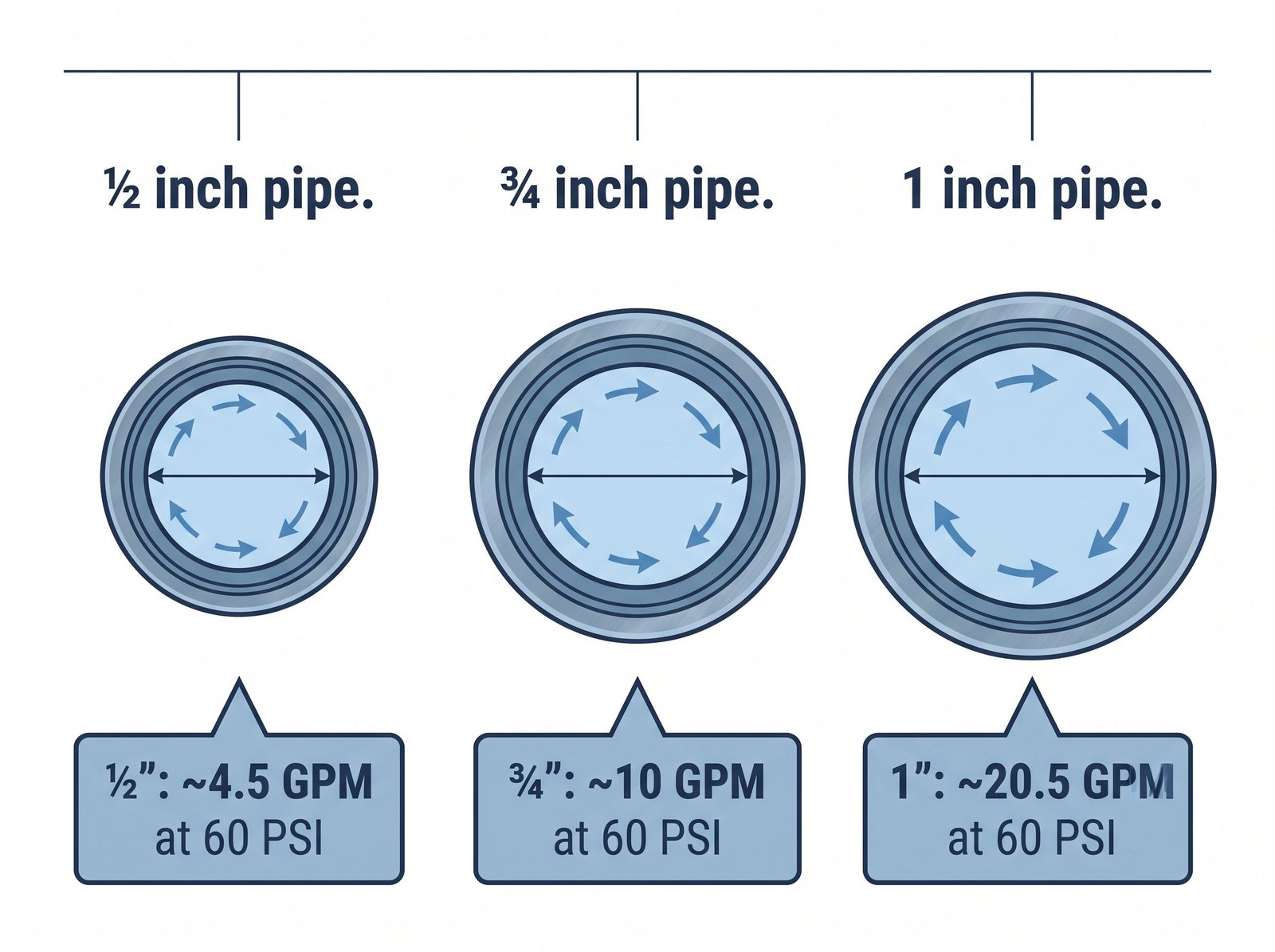
This information is only true for smooth-bore pipe under stable conditions. The presence of fittings such as elbows, valves, tees will increase effective friction and lower the GPM. A conservative rule of thumb: add 5–10% to required pipe capacity for every 10 fittings in the run.
How Many GPM Can a ½" Pipe Flow at 60 PSI?
At 60 PSI with a 10-foot run of ½" Schedule 40 PVC (C=140), the approximate flow rate is 4.5 GPM. At 40 feet, friction losses drop that to around 3.2 GPM. By 100 feet, you are looking at 2.1 GPM. This is why the question ‘how many GPM can a ½” pipe flow at 60 PSI?’ does not have a definite answer without considering the length of the run and fittings. That’s how the PSI to GPM calculator factors in run length and pipe diameter.
Pressure Washers and Nozzle Size: PSI to GPM in Action
Pressure washer performance is defined by two numbers: PSI (cleaning pressure) and GPM (water volume). The product of the two called Cleaning Units or CU determines overall cleaning power. A 2,400 PSI / 2.0 GPM washer gives 4,800 CU. A 1,800 PSI / 2.5 GPM machine will give 4,500 CU. More GPM at lower PSI will be more effective on big surface cleaning, while higher PSI at low GPM works well in detail such as stripping paint.
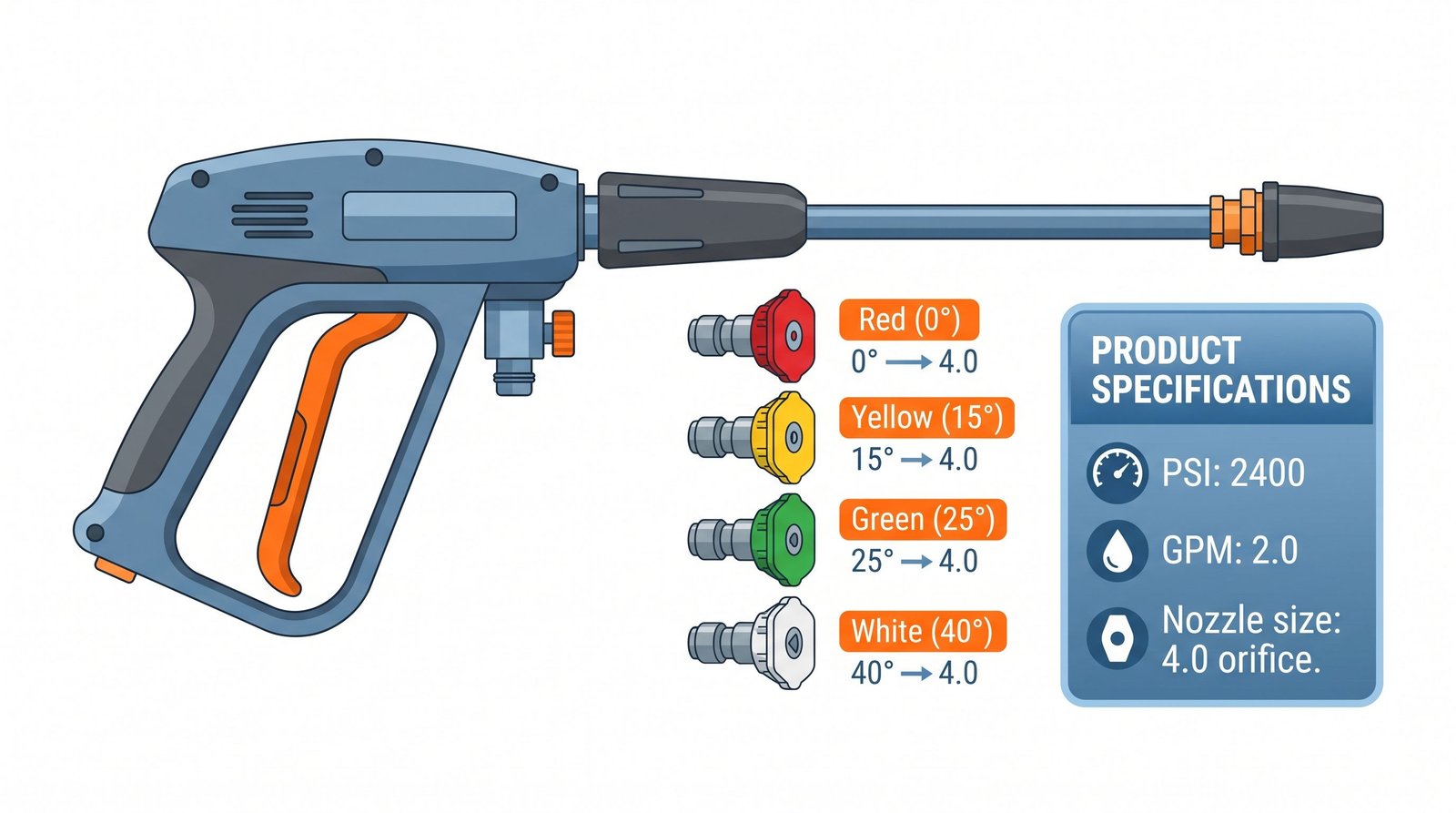
The nozzle size influences the ratio of PSI to GPM produced by the wand. When using a small opening, PSI will increase as flow rate decreases. Conversely, if a larger opening is used, the opposite is true. The pressure washer nozzle size calculator uses the orifice formula (GPM = 29.84 × Cd × d² × √P) to find the orifice diameter that achieves your target GPM at a given machine PSI. The pressure washer orifice size calculator also calculates the same using the formula but solves for d. Selecting the wrong nozzle destroys the surface, wastage of water, and puts strain on the pump. Calculating orifice size rather than guessing is the difference between effective cleaning and an expensive repair.
Who Uses a PSI to GPM Calculator and When
It is utilized by plumbers and contractors to determine the dimensions of supply pipes as well as to guarantee the flow that a newly installed fixture or appliance requires. A washing machine that requires 1.5 GPM cannot work correctly or activate the flood-control shutdown system if the water supply pipe is unable to carry enough water due to the pressure of water in the home. Irrigation specialists use the PSI to GPM conversion factor in order to determine the correct number of zones, pick the appropriate sprinklers, and make sure that the pumps can reach the needed distance. The Irrigation Association states that exact measurements of the flow rate help to save up to 15% water at home when compared to random guessing.
The formula used by pressure washer operators, industrial maintenance staff, HVAC experts, and DIY specialists working on a bathroom or an outdoor tap is the same. The flow rate calculator is built for all of these use cases in a single, straightforward interface.
How to Use the PSI to GPM Calculator on This Site
- Step 1: Choose your direction of conversion; PSI to GPM, GPM to PSI, or GPH to PSI.
- Step 2: Enter the value of either the pressure (in PSI) or the flow rate of either GPM or GPH based on what value you started with.
- Step 3: Input pipe inside diameter in inches if requested. If doing orifice/nozzle calculations, use orifice diameter.
- Step 4: Input pipe length in feet if needed. Ignore for orifice calculations only.
- Step 5: View result. Result will be displayed with clear unit’s label (GPM, PSI or GPH) and with formula used for verification. Tool works in browser and does not require any registration or subscription. Result is updated on-the-fly as you type.
Key Features of This Flow Rate Calculator
- Bidirectional: Perform conversion of PSI to GPM, GPM to PSI and GPH to PSI in the same interface.
- Pipe size aware: Input pipe diameter to get realistic flow rate instead of theoretical maximum flow rate.
- Nozzle version: Switch to orifice calculations mode to calculate pressure washer nozzle size.
- Instant results: There is no page refresh or submit button needed, as results are updated as you type.
- Absolutely free: No registration, no trial version, no limitations.
- Mobile friendly: Run tool on mobile devices and desktop without any setup.
Knowledge of the water pressure and flow rate interaction should form the basis of any water system project. Whether there is a need to size the sprinkler zone, install a new toilet, or choose the pressure washer nozzle, the PSI to GPM calculator calculates it correctly and takes into account the sizes and lengths of pipes. All tools are free and permanently available at EasyFreeCalculator.
FAQs
Not accurately. PSI measures pressure; GPM measures flow. The pipe diameter determines how much flow a given pressure can push through. Without diameter, you can only estimate using orifice formulas which give a theoretical maximum, not the real-world figure. Use the pipe size calculator mode for practical plumbing applications.
Most US municipalities deliver water to residential meters at 40–80 PSI. The International Residential Code recommends a minimum of 40 PSI at fixtures. Above 80 PSI, a pressure reducing valve (PRV) is usually required to protect appliances. At 60 PSI through a ¾" supply line, a typical home can expect approximately 10 GPM enough for two simultaneous showers and a running dishwasher.
Flow rate is represented by both GPM (gallons per minute) and GPH (gallons per hour), although the former is for minutes while the latter is for hours. 1 GPM = 60 GPH. GPH is used when flows are low drip emitters, filters, and softeners because expressing them in GPM produces fractions smaller than 1. Always remember to convert GPH into GPM before applying the flow formula whenever you are working on the conversion between PSI and flow.
All open fixtures tap into the same supply line; as more fixtures become open, the demand increases (increases the GPM), and the pressure becomes low because the pipe cannot supply a higher flow rate than the pipe diameter at a particular supply pressure.
The equation used to calculate orifice flow rate is: GPM = 29.84 x Cd x d² x √P, where Cd is the coefficient of discharge (which is 0.9 for a standard orifice), d is the orifice diameter in inches, and P is the inlet pressure in PSI. The formula can be presented in a rearranged form for the orifice size: d = √(GPM ÷ (29.84 × Cd × √P). The pressure washer nozzle calculator presented on this website automatically utilizes this formula. Just enter PSI and GPM of the machine in question to get an answer regarding the required orifice diameter automatically.