📑 Table of Contents
Most people know about how old they are but roughly, uh, is not always enough. Legal documents, medical records, school enrollment cutoffs, passport applications, and standardized testing all ask for a more exact age, calculated right up to the exact day. A dependable Age Calculator hands you that number in seconds, no manual counting to fuss with, and no danger of skipping a leap year. This article explains how age calculation works, what chronological age means and how to figure it out, what a decimal age is and when it matters, and when an online calculator is the right tool for the job.
How to Calculate Age — And Why Accuracy Matters
Calculating age sounds simple: subtract the birth year from the current year. But that single-step approach is only accurate on the exact birthday. Before the birthday in the current year, the person has not yet reached the next year of age. After it, they have. Miss this distinction and the number is off by a full year a meaningful error in any formal context.
Age calculations also have to account for varying month lengths and leap years. A child born on February 29 in a leap year presents a specific calculation challenge that doesn't exist for any other birthdate. A proper age calculator handles all of these cases automatically using the Gregorian calendar as its reference system.
According to a 2020 analysis by the National Center for Health Statistics, age-related data errors in health records are among the most common administrative inaccuracies in the US system affecting eligibility determinations, medication dosing, and insurance billing. Precise age calculation is not a minor detail in these contexts.
The Simple Formula Behind Age Calculation
The core formula compares three components year, month, and day between the birth date and the reference date (usually today). If the current month, and day land before the birthday month and day, then you subtract 1 year from the raw year gap. After that the remaining months, and days are handled separately so you end up with the complete itemized breakdown, without leaving anything out.
Like for example, say someone was born on October 15, 1990 and you’re calculating on July 13, 2026. In that case the age doesn’t come out just as 35 years (which is basically 2026 minus 1990 as you might assume at first). Instead it’s 35 years, 8 months, and 28 days old.
What an Age Calculator Actually Tells You
A full Age Calculator gives you more than just a year count. It returns your exact age in years, months, and days and many calculators also express this as total day lived, total months, or total weeks. The Time Duration Calculator covers similar ground for general time gaps between any two dates, while the age calculator focuses specifically on age from a birthdate.
This level of detail matters in several real-world situations. Pediatric drug dosing is often calculated based on a child's age in months, not years a difference between 23 months and 24 months can shift a dosing category. Retirement plan eligibility under US tax law depends on the exact date a person turns 50, 55, 59½, or 72. Insurance underwriting tends to use an age-at-last-birthday convention, which really means you have to figure out if the birthday has already passed this year, or not.
The age calculator makes all of this kind of clean and tidy: it gives you years, months, days, and also the grand total in each unit. You just enter the birth date and the calculation date, and the output covers every format you might need, pretty much.
What Is Chronological Age — and How Do You Calculate It?
Chronological age is simply the time that has passed since a person was born, measured on a standard calendar. It is the most straightforward type of age as opposed to developmental age, bone age, or biological age, which all involve assessment rather than calculation. An online chronological age calculator takes a date of birth and a target date and returns the elapsed time in years, months, and days.
The term is used most often in education and clinical assessment, where age needs to be stated precisely to interpret a test score correctly. A child’s performance on a reading or cognitive assessment is always put side by side with other children of the same chronological age. If there isn’t an accurate age, then the comparison group comes out wrong, and honestly the whole way the score gets interpreted becomes meaningless, like it doesn’t really say anything.
How to Figure Out Chronological Age Step by Step
To figure out chronological age manually: take the testing date, subtract the birth date. Start with the years: if the testing month and day fall before the birth month and day, the age in completed years is the year difference minus one. Then calculate the remaining months from the adjusted start, and the remaining days within the final month.
In practice, this is a three-step subtraction with borrowing across calendar boundaries which is where manual errors occur. A dedicated chronological age calculator, uh, it handles the whole process for you, no real need for any arithmetic on your part. You just enter the birth date, then you enter the testing date and the tool gives back the exact age in years, months, and days, like straight away.
Decimal Age and Age Calculators for Testing
What Is a Decimal Age?
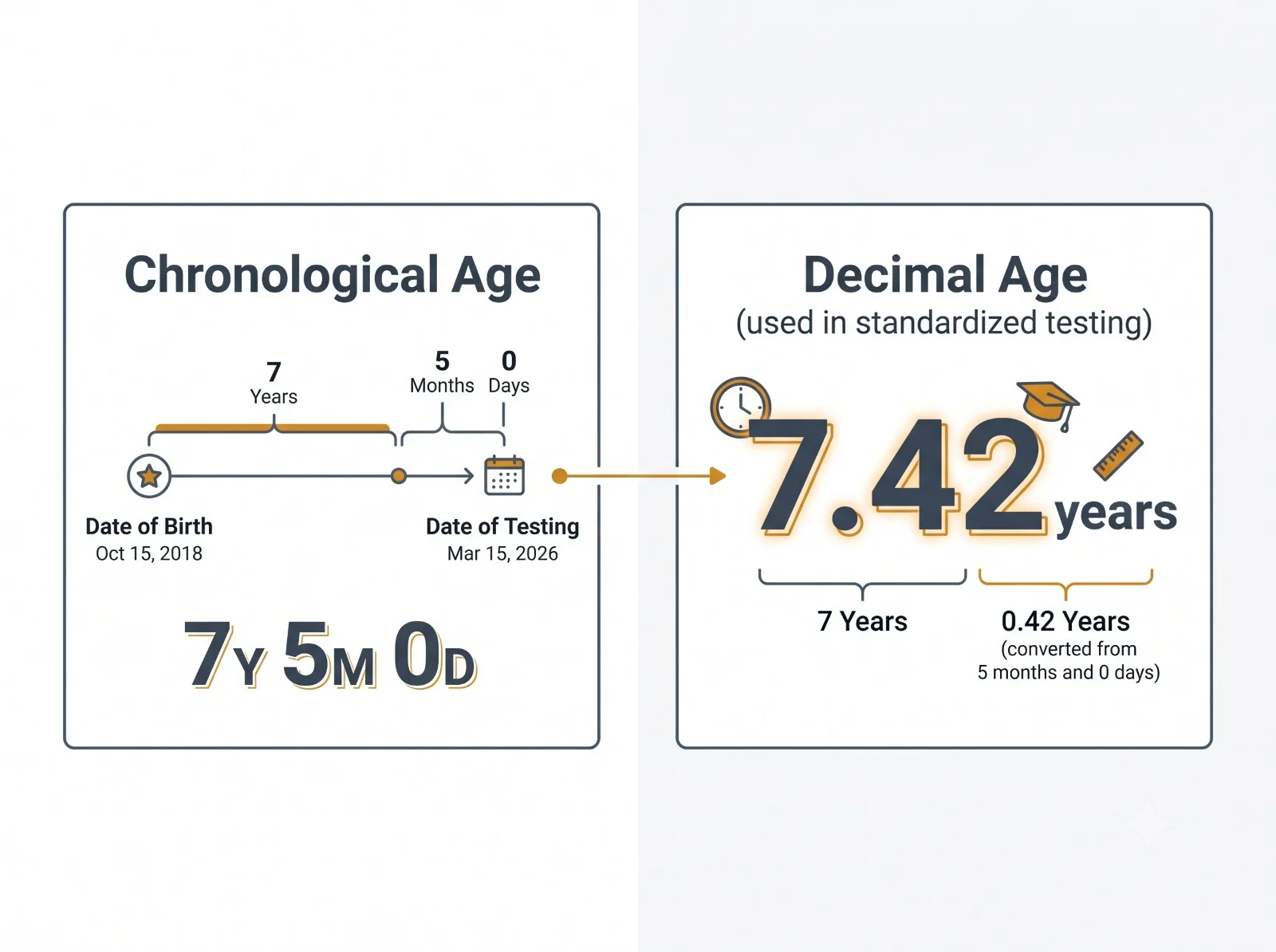
A decimal age is when a person’s age is shown as basically one number, with a decimal point, like 7.42 years instead of saying “7 years and 5 months”. Most of the time it comes from taking the full number of months and dividing by 12…or, more precisely, dividing total days by 365.25, since that is the average length of the calendar year once leap years are mixed in. Decimal age is used when a pretty specific fractional age is needed for statistical comparison or for a quick norm-table lookup. Like, an age of 7 years, 5 months, converts to something around 7.42 in decimal form. Then that decimal number is used to figure out the right age band in the norm table, and that is what actually helps decide how a test score is interpreted, compared with peers.
Age Calculators Used in Standardized Testing (Pearson and Others)
Psychologists, speech-language pathologists, and educational assessors frequently need a test age calculator when scoring assessments. Publishers like Pearson publish norm-referenced tests where every score depends on the test-taker's chronological age on the date of testing, expressed in years and months or as a decimal.
A Pearson age calculator or any age calculator for testing works by computing the exact years, months, and days between date of birth and date of testing. The result is then used to locate the correct column in the norm table. An error of even one month places the score in the wrong comparison group, which can change the interpretation significantly.
Tools like the Super Duper age calculator (used in speech therapy contexts) and Pearson's own internal calculators serve the same function: precise chronological age for assessment interpretation. A free online chronological age calculator delivers the same result without any proprietary software.
When to Use an Online Age Calculator vs. Manual Calculation
Manual age calculation is feasible when precision is not required estimating someone's age for casual conversation, or quickly checking if a child is old enough for a program. For anything formal a legal document, a medical record, a standardized test, a benefit eligibility check manual calculation introduces too much risk of error.
The Date Calculator is handy when the question is more like “what’s the gap between these two dates” not really age, if you think about it. If you’re doing age from a birthdate though, the age calculator is more direct, just put in the date of birth, pick the calculation date, and you get the outcome in years, months, days, plus total units.
Every single calculation on EasyFreeCalculator runs on the Gregorian calendar and it considers leap years and the way month lengths change, and also the difference between actual calendar years and average years, which matters more than people expect sometimes. The results are accurate to the day the same standard expected in professional and legal contexts.